 Into The Music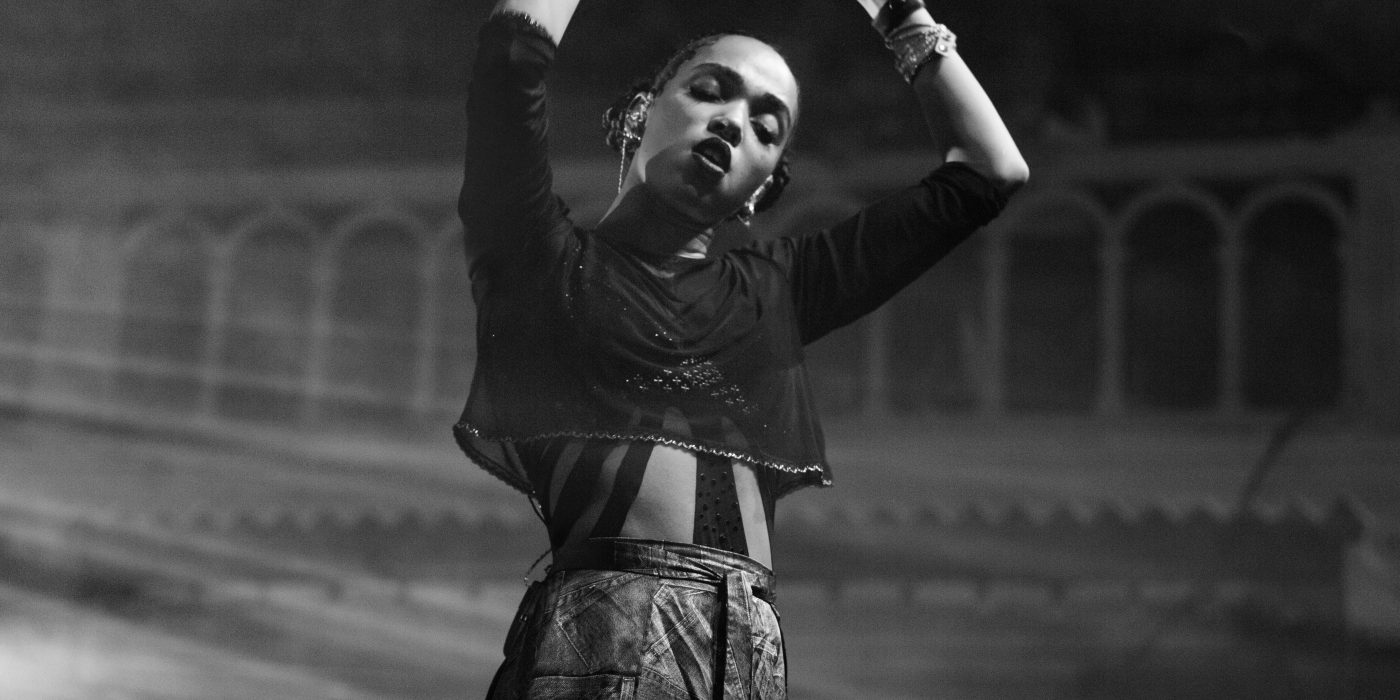
The idea of a movie about a pop star is nothing new. What makes Mother Mary, the A24 film arriving in limited theaters on April 17, worth paying attention to before anyone has even seen it, is the question of who is making the music.
Anne Hathaway plays Mary, a pop star. FKA twigs plays her estranged friend and stylist. That casting alone is an interesting choice, putting one of the most inventive and physically demanding performers in contemporary music in a supporting role in a film about a fictional pop star played by an actress. But the project goes further than that. The soundtrack, released April 17 via A24 Music, is being treated as a genuine creative object, not promotional material.
“My Mouth Is Lonely for You,” the second single to emerge from the film, was written by FKA twigs, with additional credits from Koreless, Xquisite Korpse, Tobias Jesso Jr., and Jeff Bhasker. Hathaway sings it. The first single, “Burial,” was co-written by Hathaway, Charli XCX, Jack Antonoff, and George Daniel of The 1975. These are not the people you hire to generate background texture. These are people who are actively making some of the most interesting pop music around right now.
The question Mother Mary is quietly raising is one the music industry has mostly avoided examining directly: what is the relationship between the person whose face is on a record and the people who actually made it?
This is not a new question. Songwriter culture has always existed. The Brill Building ran on it. Motown ran on it. Max Martin has co-written or produced an almost uncountable number of number-one records across four decades, and his name means something to the industry but not necessarily to the people buying the music. The gap between performer and creator has been a feature of pop since pop existed.
What’s changed is how visible that gap has become. FKA twigs writing a song for Anne Hathaway to perform in a movie, within a fictional narrative about pop stardom, is almost aggressively self-aware about this dynamic. It’s not hidden. The credits are right there. The conversation is the product.
Charli XCX and Jack Antonoff co-writing a song together is not a surprise, they’ve worked in adjacent spaces for years. But doing it for a fictional character in a film described as a “thrilling psychosexual pop opera” is different from doing it for Taylor Swift or Carly Rae Jepsen. The fictional frame changes what the music can say. Mary doesn’t have a reputation to protect. She can be reckless in ways a real artist might not risk.
David Lowery directing is another layer here. Lowery made A Ghost Story and The Green Knight, films that are formally precise and emotionally strange. He is not a director known for pop spectacle. A24 pairing him with a movie that requires pop spectacle suggests they’re aiming at something more complicated than a music biopic or a star vehicle.
The Hathaway casting matters because she is explicitly not a pop star. She sang on Les Misérables and Rio, but nobody thinks of her as a musician. Putting her in this role, with a soundtrack written by actual pop architects, creates a productive tension. The artifice is part of the point. The film is presumably about what it costs to be a pop star, which means the soundtrack is doing double duty as evidence of that cost.
Whether Mother Mary delivers on any of this remains to be seen. A24 has earned enough trust over the years to get the benefit of the doubt on a project this self-consciously constructed. But the soundtrack alone is worth paying attention to right now, because the people involved have made it into something that matters on its own terms, separate from whatever the movie turns out to be.
That’s a harder thing to pull off than it looks. Pop music made for a fictional context usually sounds like exactly that: functional, inert, designed to work inside a story rather than outside it. “My Mouth Is Lonely for You” does not sound like that. Neither, apparently, does “Burial.” What’s happening here is more interesting than soundtrack work, and it raises questions about authorship and performance and the architecture of pop stardom that the music industry usually prefers not to examine this directly.
April 17. Watch what happens when it lands.