 Into The Music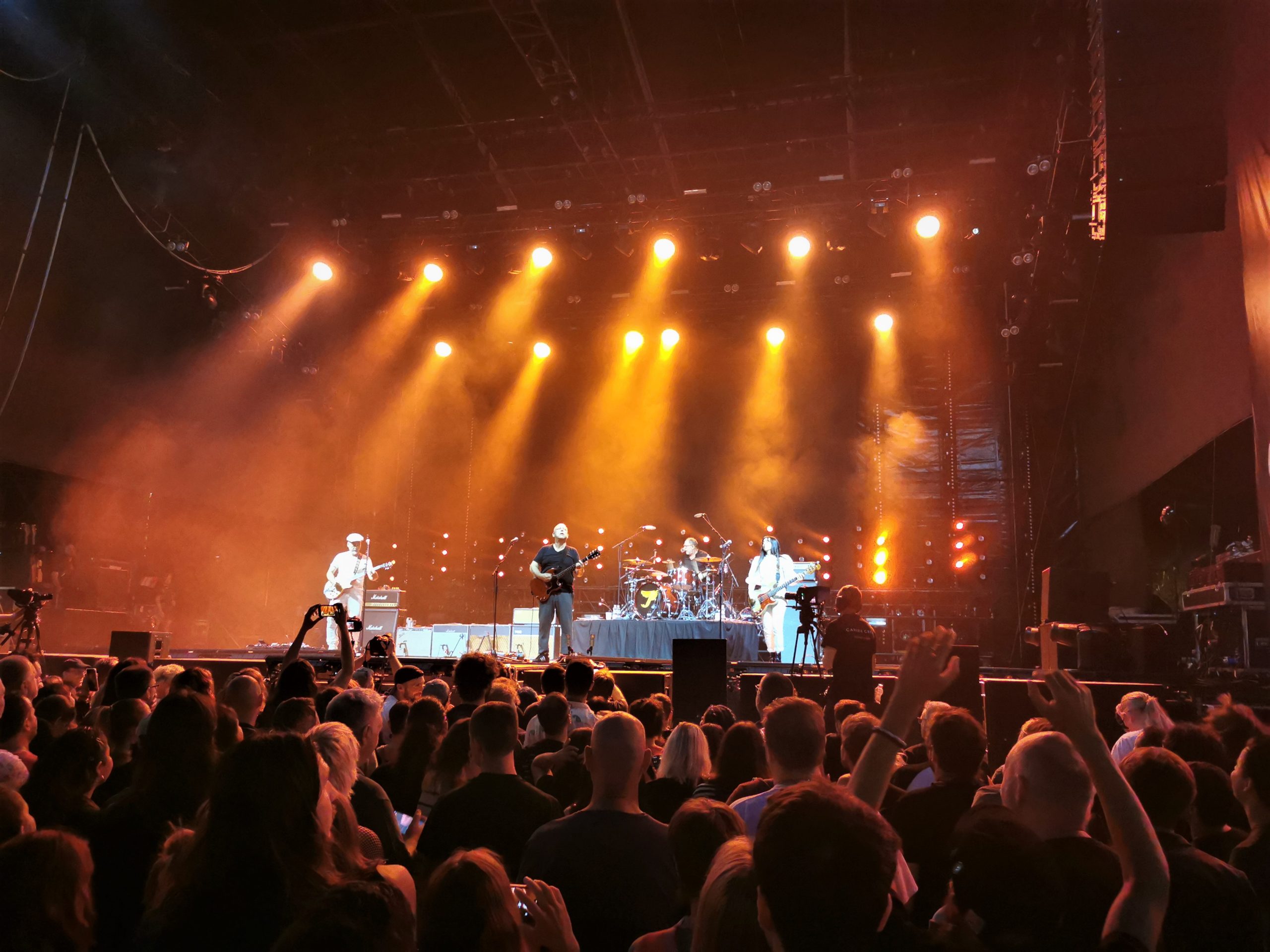
There is a particular kind of band that gets called “influential” so often the word starts to lose its meaning. Pixies are that band. You cannot count the number of artists who have cited them as a reason they picked up a guitar or started writing songs that didn’t resolve neatly. Kurt Cobain said it directly. Radiohead have said it in various ways across multiple interviews. The entire architecture of 1990s alternative rock runs through Boston, Massachusetts, 1986, where four people assembled something that wasn’t quite punk, wasn’t quite pop, and wasn’t quite art rock but contained all three of them in some volatile combination.
Now, with a set of 40th anniversary US shows announced for later this year, it feels like an appropriate moment to take stock of what the Pixies actually built and why it has held together this long.
Black Francis, Kim Deal, Joey Santiago, and David Lovering formed the band while Black Francis and Santiago were exchange students in Puerto Rico and came back to Boston with something that felt, as Francis has described it, like a personal obsession needing an outlet. Their debut EP, Come On Pilgrim (1987), and the first full album, Surfer Rosa (1988), established their central tension immediately: Francis screaming over Santiago’s discordant guitar while Deal held down the bottom with melodic basslines that had no business sounding as catchy as they did.
The loud-quiet-loud dynamic that everyone associates with Pixies is real but somewhat reductive as a summary. What they actually did was move between registers of intensity with a kind of controlled recklessness, the way a good driver takes a corner fast but never actually loses control. Doolittle (1989) is probably their peak document, a record so dense with hooks and weirdness that it still sounds startling thirty-five years later. “Debaser,” “Gouge Away,” “Here Comes Your Man,” “Monkey Gone to Heaven”: each one operates differently, each one sounds like nothing else on the record, and yet the album is coherent as a whole. That’s a hard trick to pull off.
The band split in 1993, famously announced by Francis in a fax to the press, and spent a decade apart while Deal went on to lead the Breeders to their own critical peak and Francis released records as Frank Black. The 2004 reunion was greeted with the kind of enthusiasm usually reserved for things people were afraid they’d never get to see. They’ve been intermittently active since, releasing Indie Cindy in 2014 and Head Carrier in 2016, though neither captured the critical fervor of the early work. Deal departed again before Head Carrier, and the band has continued as a three-piece with additional musicians filling the lineup.
What does it mean to mark 40 years? For a band like the Pixies, it means sitting with the fact that your most enduring work was done when you were barely old enough to know what you were making. The raw, formally strange, lyrically oblique records from 1987 to 1991 are the ones that matter to people who care about guitar music. That’s not a dismissal of what came later. It’s just an acknowledgment that sometimes an artist hits something early and the rest of their career is partly in conversation with it.
The 40th anniversary shows are a reason to revisit the catalog from the beginning. Start with Surfer Rosa, which still sounds like something being invented in real time. Work forward. The influence will start to feel less abstract and more like a specific set of decisions made by four people who didn’t fully know what they were starting.
Origin: Boston, Massachusetts. Active: 1986 to present, with hiatuses. Essential entry point: Doolittle (1989). If that lands, go backward to Surfer Rosa and forward to Trompe le Monde. Everything else follows from there.