 Into The Music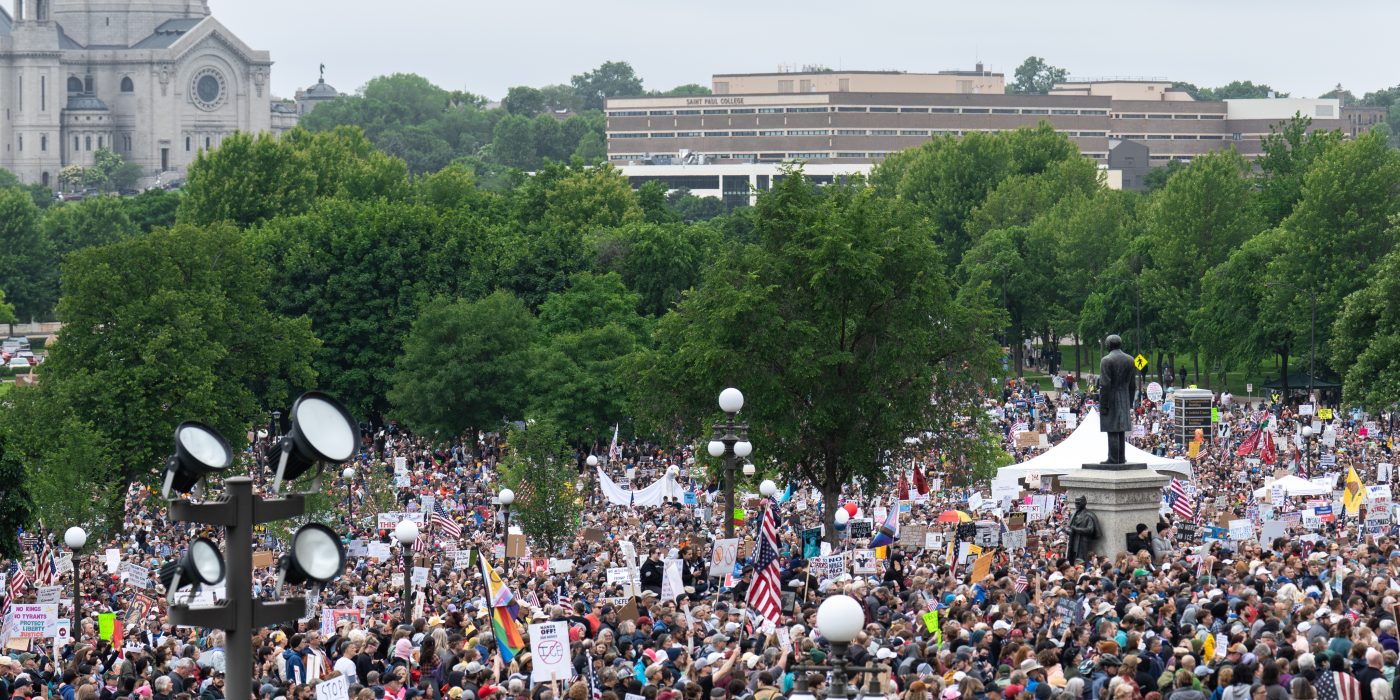
The question people keep asking about protest songs is whether they actually work. It is a reasonable question framed in the wrong way. Protest songs do not topple governments. They do not change votes by themselves. They do not stop wars on the day they are released. But the question of what protest songs actually do is more interesting than the question of whether they work, because the answer turns out to be both less and more than what we expect.
Bruce Springsteen performed “Streets of Minneapolis” at the No Kings rally in St. Paul this weekend, and it was his third live performance of the song since he wrote it in the aftermath of the ICE killings in Minneapolis earlier this year. Watching the coverage, you could feel people reaching for language to describe what was happening. Was it meaningful? Was it performative? Was it brave? These are all the wrong questions. The right question is what a song does when it arrives at the right moment for the right crowd in the right place, and the answer is that it transforms a gathering of individuals into something that functions like a community.
That is not a small thing. It is actually quite hard to accomplish and very few people can do it.
The history of protest music is not primarily a history of songs that changed policy. It is a history of songs that made people feel less alone in their opposition to something. Billie Holiday singing “Strange Fruit” in 1939 did not end lynching. But it named the thing clearly and undeniably in a room full of people who knew what was happening in the American South and had to sit with that knowledge instead of looking away. Pete Seeger’s work with labor unions in the 1940s and 50s did not itself build the union movement, but it gave that movement a sonic identity that made gatherings feel more like gatherings, which is a form of organizing that is easy to underestimate.
The anti-war movement of the 1960s produced some of the most celebrated protest music in American history, and it is worth asking what that music actually contributed. Dylan’s “Blowin’ in the Wind” arrived in 1963 and became a civil rights anthem because it asked questions that felt unanswerable and then let that feeling of impossibility sit without resolving it. Country Joe and the Fish’s “I-Feel-Like-I’m-Fixin’-to-Die Rag” did something different: it used the forms of absurdist humor to make the machinery of war seem monstrous rather than inevitable. Both strategies worked. Both worked by giving people a shared object around which to organize their feelings.
In more recent history, the relationship between music and political movements has gotten more complicated. Beyonce’s Lemonade was immediately political in ways that were also deeply personal. Kendrick Lamar’s “Alright” became a Black Lives Matter anthem before it was clear what that movement would become. Neither of those artists set out to write movement anthems. The movements found the songs and claimed them, which is actually how it usually works.
What Springsteen is doing this year is more deliberate. He wrote “Streets of Minneapolis” specifically in response to specific events and then traveled to the city to perform it and then traveled to the state capitol to perform it again. That kind of intentionality is unusual. Most protest music arrives sideways, discovered rather than delivered. But the directness of what Springsteen is doing is itself a kind of argument about what artists owe this moment. The Land of Hope and Dreams Tour, by his own description, is going to be politically charged from start to finish. He is not hedging or dipping a toe in.
That choice will have costs. Some portion of his audience will not want politics at a rock concert, a perspective that reveals more about the politics of that position than the people who hold it usually recognize. But the historical record suggests that artists who are specific and committed tend to produce work that lasts, while artists who are careful and neutral tend to produce work that ages into irrelevance. “Strange Fruit” is still being performed. “Blowin’ in the Wind” still sounds like it was written last week. “Streets of Minneapolis” is six months old and it is already doing the thing that songs that matter do, which is attach itself to a moment so completely that the two become inseparable.
Protest songs work by making the present feel real and nameable and shared. That is not nothing. In fact, when you are in a crowd of thousands outside a state capitol and someone is singing directly about the people who were killed in your city, it might be the most important thing in the room.