 Into The Music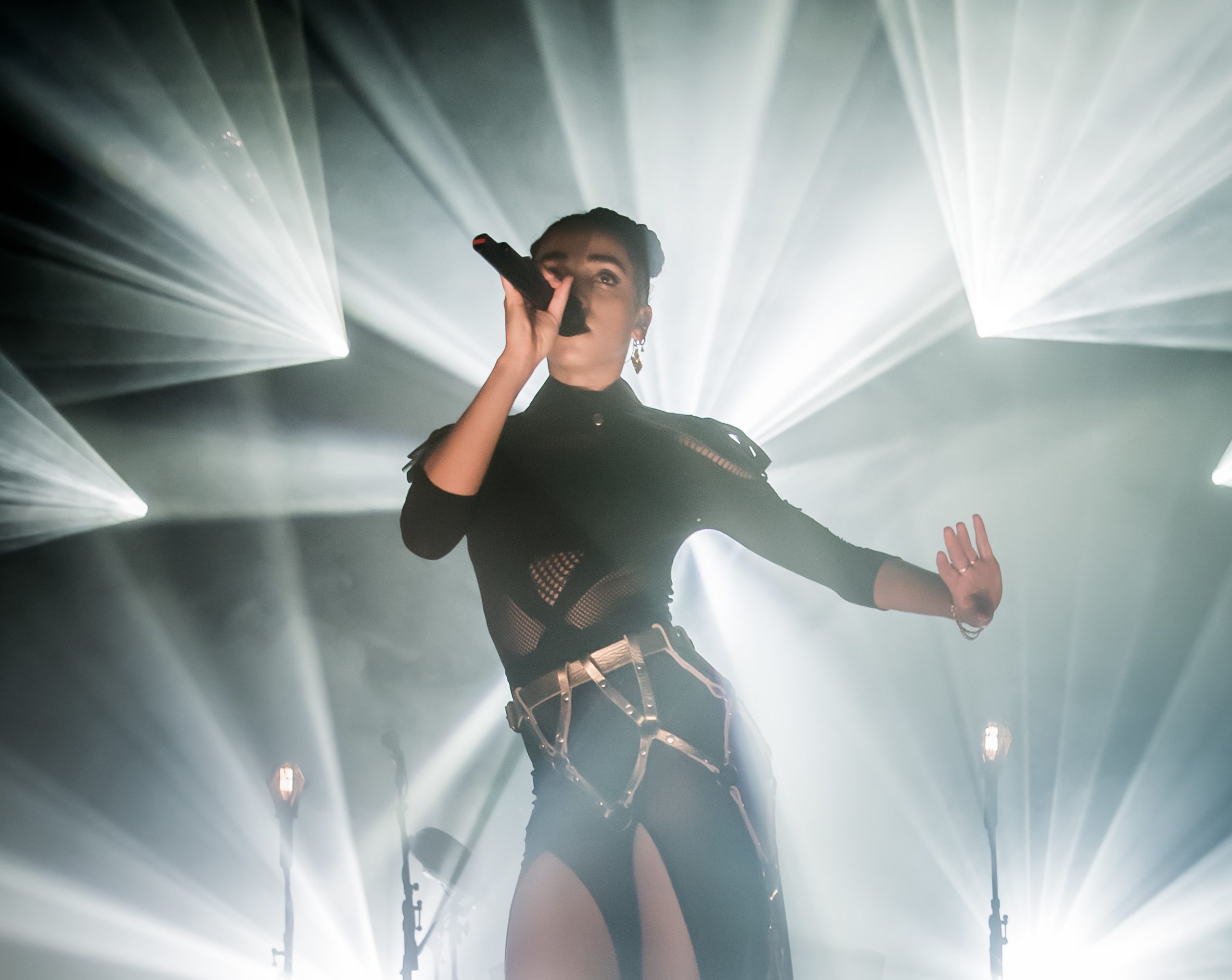
FKA Twigs has been one of the most genuinely difficult artists to pin down for the better part of a decade, and she has spent 2026 making that quality into a feature of her live show. The Body High Tour, which brought her to Madison Square Garden in March, is not a concert in the conventional sense. It is closer to a durational performance piece that happens to include music, and the fact that it keeps selling out arenas says something interesting about where the audience is right now.
Born Tahliah Debrett Barnett in 1988, she grew up in Cheltenham, England, and started as a backup dancer before releasing her 2012 EP under the FKA Twigs name. The “FKA” stands for “formerly known as,” a necessary distinction because another artist had already claimed the Twigs name. The workaround became part of the identity.
Her first full-length record, LP1, arrived in 2014 and immediately established her as something apart from the R&B conversation she was nominally adjacent to. The production, largely handled by Arca and Malay, was glacial and pressurized. Her voice sat in the mix like a separate instrument. Critics noticed. General audiences took longer, which is usually how it goes with artists who are genuinely ahead of their moment.
Magdalene in 2019 pushed further into orchestral territory and was, by most accounts, her most emotionally transparent record. She made it during a period of considerable public difficulty, including a lawsuit against Shia LaBeouf and a diagnosis of fibroid tumors that required surgery. The album arrived with a strange serenity. It did not perform catharsis for the audience. It simply existed, which is a harder thing to do than it sounds.
The years since have seen her move through several different registers: the mixtape Caprisongs in 2022 was her most accessible project, genuinely warm in ways her earlier work was not. The 2025 double release of Eusexua and Eusexua Afterglow split her audience in interesting ways. Some found it alienating. Others found it the most coherent statement she had made since Magdalene. Both responses tracked with the same fundamental quality: she does not make music for consensus.
The Body High Tour is built around that double record, and Tokischa joined her at Madison Square Garden in March, adding a different kind of physicality to a show already defined by movement. FKA Twigs has trained extensively in pole dance and other physically demanding performance forms, and her choreography is part of the work in a way that is not true for most artists who use dancers. She is not gesturing at the body. She is using it as a primary instrument.
What makes her interesting beyond any individual record is the consistency of her refusal to consolidate. She does not make the same album twice. She does not give interviews that translate easily into press releases. She has filed a lawsuit, talked openly about medical trauma, appeared in films, choreographed pieces for other artists, and at every turn seemed more interested in what she had not done yet than in capitalizing on what she had already done.
The MSG show was reportedly extraordinary. Based on the available evidence, it probably was.