 Into The Music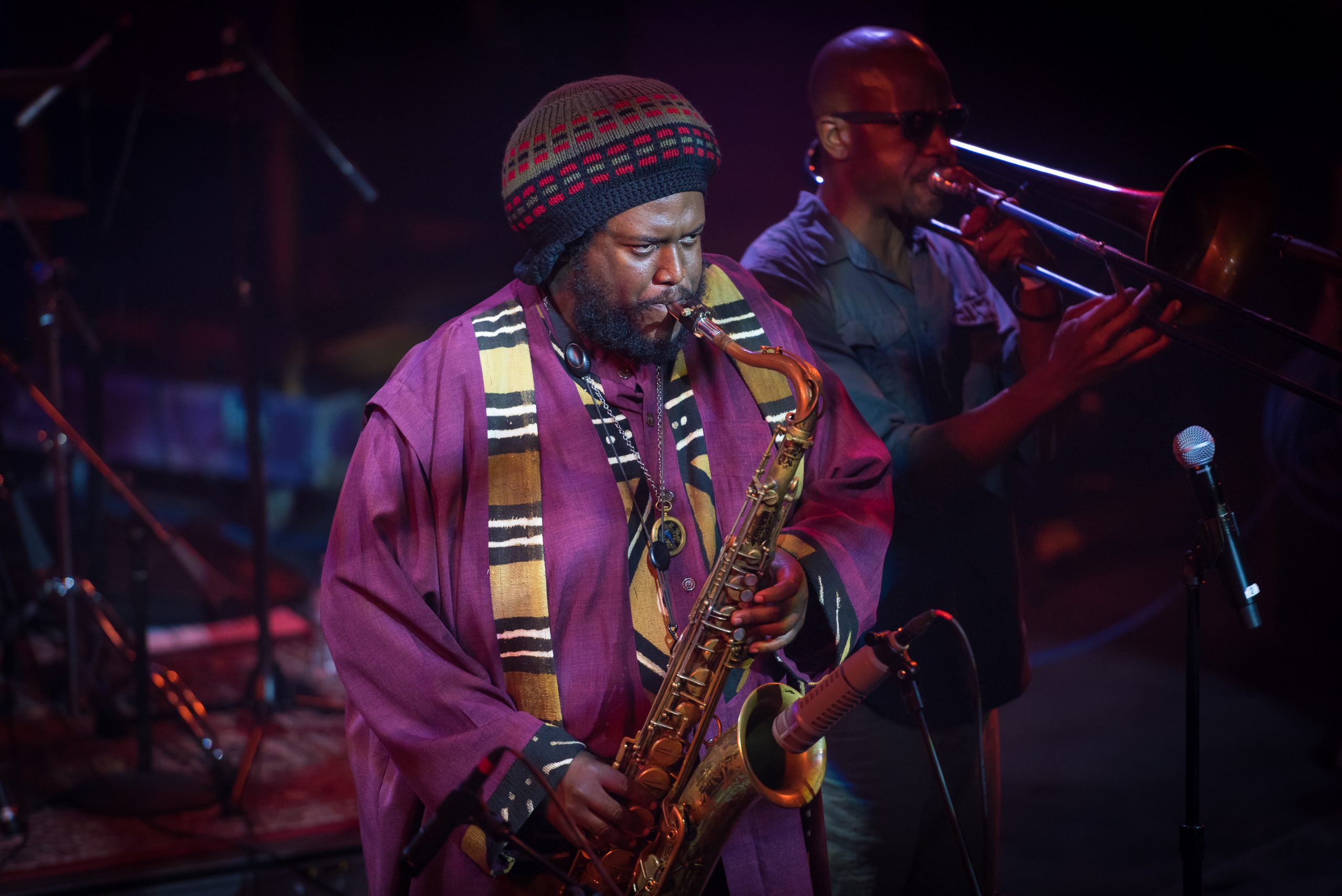
Kamasi Washington did not arrive quietly. His 2015 debut The Epic was three hours long, featured a 30-piece orchestra and a choir, and announced itself as a work of enormous ambition from a musician who had spent years playing in other people’s sessions. It was the kind of debut that changes a conversation, and it did.
What it changed, specifically, was the conversation about whether jazz could still be the center of something. For a long stretch before 2015, jazz had been present in music culture largely as an influence, a reference point, a thing that had already happened. The Epic made the argument, in three hours and with considerable force, that it was still happening and still capable of producing work that felt like an event.
Washington grew up in Los Angeles, the son of Rickey Washington, who is himself a foundational figure in the city’s jazz world. He started playing the tenor saxophone at age 12 and came up through a scene that has consistently produced musicians with an unusual ability to hold multiple traditions at once. The Los Angeles jazz scene is different from New York’s in ways that are hard to summarize briefly, but the short version is that it has always been more porous, more willing to absorb influences from the adjacent worlds of soul and funk and hip-hop and gospel. Washington is a product of that porousness.
The connection to hip-hop was made explicit when he appeared on Kendrick Lamar’s To Pimp a Butterfly in 2015, the same year The Epic came out. His saxophone runs on that record are as well-placed as anything on the album, which is saying a great deal given the quality of everything else on it. The timing was not accidental. Washington was part of a community of Los Angeles musicians who had been building toward something, and 2015 was when the building became visible from outside.
His subsequent records, Harmony of Difference and Heaven and Earth, expanded the project in different directions. Harmony of Difference is a meditation on counterpoint and difference, six studies in how distinct voices can resolve into something coherent. Heaven and Earth is bigger and more varied, moving between the ecstatic and the reflective in ways that sometimes work and sometimes reach a bit further than the material can support. Neither record is as self-evidently overwhelming as The Epic, but they demonstrate that Washington is thinking about what he does in ways that go beyond simply making jazz albums.
He has also been generous with his presence. He shows up on other people’s records. He performs at festivals. He talks about jazz in interviews with an enthusiasm that does not read as evangelical, which is a rarer quality than it should be among advocates for a genre. He seems to understand that the audience he wants is an audience that does not need to be persuaded that jazz is serious. It is serious. He wants to show them that it is also pleasurable and immediate and alive.
The influence Washington has had on what followed him is visible in how much has followed him. The London jazz scene that emerged around the same time, with musicians like Shabaka Hutchings and Nubya Garcia and Moses Boyd, was doing something parallel rather than derivative, but the cultural space for that work was partly opened by the size of what Washington did in 2015. The argument that serious jazz could find a large and engaged audience was made credible, in part, by The Epic.
Ten years on from that debut, Washington is one of the most significant figures in contemporary jazz and one of the musicians most responsible for the current moment in the genre. The connection his father Rickey made to a young Flea, teaching him trumpet while serving as a mentor to the Los Angeles jazz world, is one of those connective tissue details that appear in music history and reveal how dense the network actually is. Everything connects. Washington is one of the clearest and most productive nodes in that network.