 Into The Music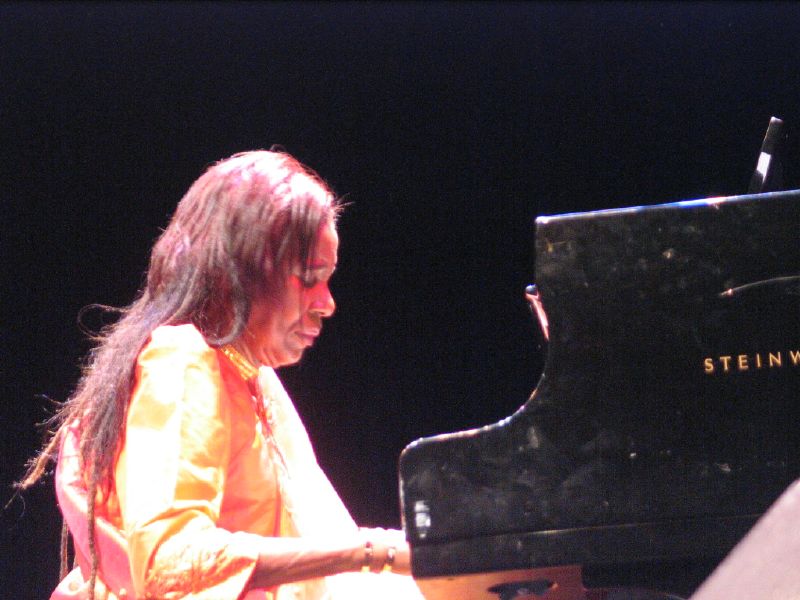
When David Byrne, Flying Lotus, and Alice Coltrane’s son Ravi speak about her legacy in the same breath, you start to understand the unusual position Alice Coltrane occupies in music history. She is not a footnote. She is a root system. The question is why it took so long for that to become common knowledge, and why the answer matters for how we understand who gets to be called an influence.
Alice Coltrane died in 2007. In the years since, her music has moved from “John Coltrane’s widow” territory into something more accurate: one of the most genuinely singular composers of the twentieth century, whose work touched jazz, Indian classical music, spiritual practice, and electronic texture in ways that still feel ahead of where music is right now. Flying Lotus, who is her great-nephew, has talked about the family’s archive of her ashram recordings, privately pressed records that circulated among devotees for decades before a wider world caught up. Those recordings, “World Spirituality Classics 1: The Ecstatic Music of Alice Coltrane Turiyasangitananda,” were released officially in 2017. The response confirmed what had already been quietly understood: this was extraordinary work.
The harp is central to why Coltrane’s music feels the way it does. She came to it from piano, where she was formidable, and applied a pianist’s harmonic sensibility to an instrument that most jazz musicians treated as decorative if they touched it at all. The result was something that sounded like both a string instrument and a keyboard simultaneously, cascading and vertical at once. Combined with her use of organ, her later incorporation of synthesizer, and her immersion in the drone-based structures of Indian classical music, she created a sound that had no real predecessor and has produced no real imitator, only practitioners trying to approximate certain qualities of it.
The spiritual dimension of her work was not separate from the musical dimension. After John Coltrane’s death in 1967, Alice deepened her practice of Vedanta and eventually became a swami, taking the name Turiyasangitananda, meaning “transcendental bliss through music.” The ashram she founded in California became the context in which the later recordings were made. This is sometimes treated as a turn away from music toward religion, but that reading misses how completely the two were the same thing for her. The music on those ashram recordings is not background for meditation. It is its own complete thing, with harmonic sophistication and emotional intensity that does not need a spiritual framework to hit hard. The framework is just where it came from.
Her influence on contemporary music is hard to map cleanly because it travels through feel rather than direct citation. You can hear it in the harp-and-drone work of certain ambient musicians. You can hear it in the way Flying Lotus structures space and silence. You can hear it in the spiritual jazz revival that has produced records from artists like Kamasi Washington and Shabaka Hutchings. Washington has talked about her as a formative influence. Hutchings has made the lineage explicit in interviews. But you can also hear traces of her sensibility in music that would never call itself jazz, in the way certain electronic artists use long tones and textural layering, in the patient, unhurried relationship with time that her music models.
The undervaluation of Alice Coltrane’s solo work during her lifetime was not an accident. She was Black, she was a woman, she was deeply identified with her late husband’s legacy, and her music was explicitly spiritual in ways that made secular critics uncomfortable. The jazz world in the late 1960s and 1970s was not particularly welcoming to any of those things. Some of her best records sold poorly on release and were out of print for decades. The rediscovery that has happened since her death is genuine, but it also carries a familiar shape: the overdue recognition that arrives when the people who dismissed something are no longer the ones setting the terms.
What does it mean for music to have that kind of root system? It means the influence is structural rather than stylistic. People are not copying Alice Coltrane. They are building in a world where she existed, in a tradition she helped shape, in a sonic vocabulary that is partly her vocabulary whether they know it or not. That is a different kind of importance than being trendy or having a signature sound that gets sampled. It is the kind that takes decades to fully see.
We are finally seeing it. The question going forward is how we ensure the next Alice Coltrane does not have to wait until after she is dead for the work to be taken seriously on its own terms.