 Into The Music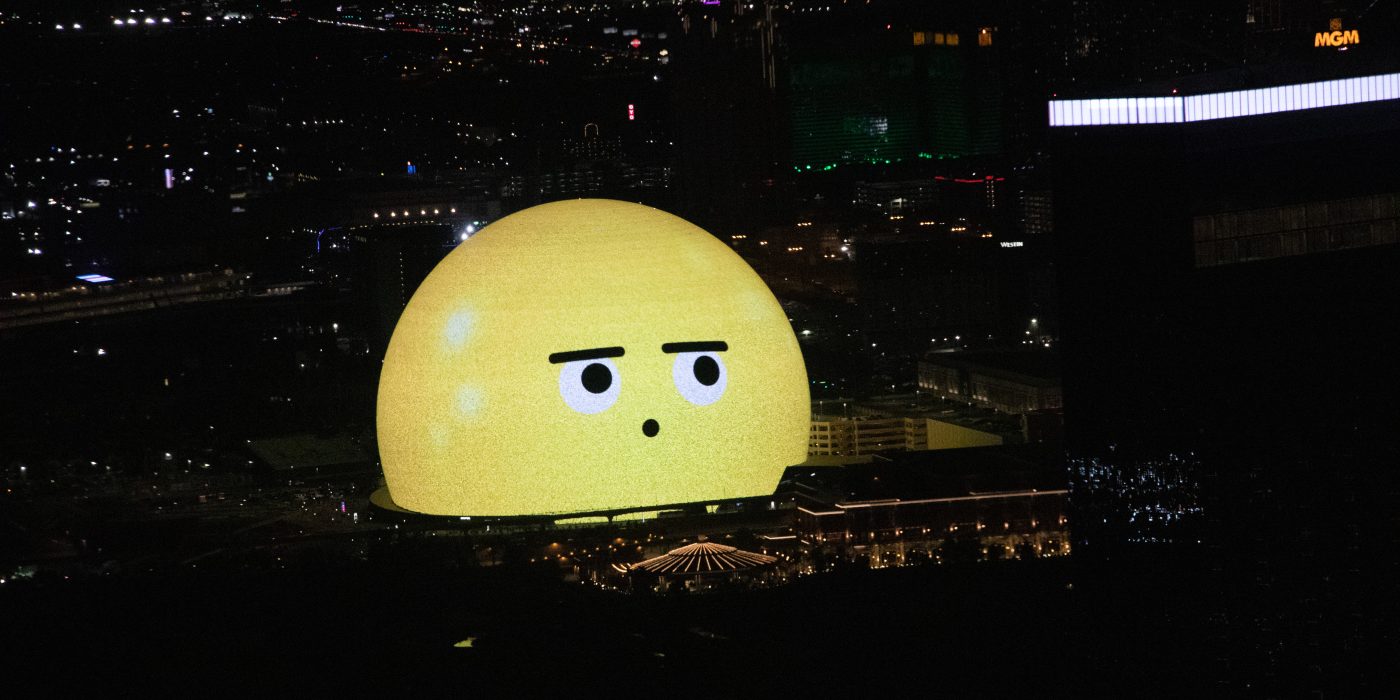
The Sphere in Las Vegas opened in 2023, and the argument about what it means for live music has not resolved itself. It probably should not. The venue is genuinely strange, a 366-foot-tall ball clad in the world’s largest LED display, containing inside it a 160,000-square-foot screen that wraps around its audiences in 16K resolution with spatial audio built into every seat. It is not a concert venue that can be understood by reference to what came before it. And that is the problem worth talking about.
U2 inaugurated it with a residency that ran for months and became something closer to a theatrical experience than a concert. The band stood on a relatively small stage while vast cinematic imagery moved through the dome above and around them. Critics split on whether it was transcendent or whether it flattened the band into something secondary, a live component inside a visual installation rather than the main event. Both responses were legitimate.
Dead and Company followed with a run that leaned harder into psychedelic visual storytelling, which made intuitive sense for that audience, and apparently the fit was strong enough to extend. Then Phish did a New Year’s run. The Sphere was finding its audience, and the audience, predictably, skewed toward jam bands and legacy acts whose fans had cultivated a relationship with the concert as ritual and with the spectacle as part of the ritual.
Metallica, announced for October 2026, will push the format somewhere it has not been. The band is a legitimate arena-filling act with a fanbase that expects the concert experience to feel physical, loud, and confrontational. The Sphere’s haptic technology, the seats that respond to bass frequencies and impact moments in the music, is either going to make this feel revelatory or gimmicky, and there is genuinely no way to know in advance which it will be.
But the larger question the Sphere raises is not about any single act. It is about whether the venue represents a direction the whole industry is heading, or a very expensive experiment that will remain an outlier. The construction cost was reported at somewhere north of two billion dollars. No one is building another one next year. Whatever it represents as a model, it is not a scalable one, not at that capital intensity.
What it might be is a forcing function. The Sphere demonstrates, as a proof of concept, that there is an audience willing to pay significant money for a concert experience that is categorically different from a standard arena show. That audience exists. The prices they pay to be in those seats confirm it. The question for the broader industry is whether that appetite can be met with more modest technological investments in other venues, or whether the Sphere is simply a cathedral at the end of a road that most venues cannot afford to walk down.
There is also a question about the music itself. Every act that has played the Sphere has, to varying degrees, adapted their approach to the venue’s affordances. The stage is relatively small. The screens are everywhere. A band that relies on physical scale, on the feeling of being dwarfed by the production, has to recalibrate. A band that relies on intimacy, on the feeling of connection between performer and room, has to find new ways to create that when the room is a digital dome capable of simulating any environment the production team can imagine.
This is not necessarily a bad thing. Constraints produce creativity. But it does mean that whatever is happening inside the Sphere is, increasingly, something other than a concert in the sense that rock and roll has used that word for the past seventy years. It is a concert as immersive theatrical event, the performer embedded in a designed experience rather than standing in front of it. Whether that is an evolution or a mutation is a question that will not have a clean answer for a while yet.
For now, the tickets keep selling. The format keeps attracting artists with the budgets and the catalog weight to justify the production. And the rest of the industry watches and takes notes, not entirely sure what they are looking at.