 Into The Music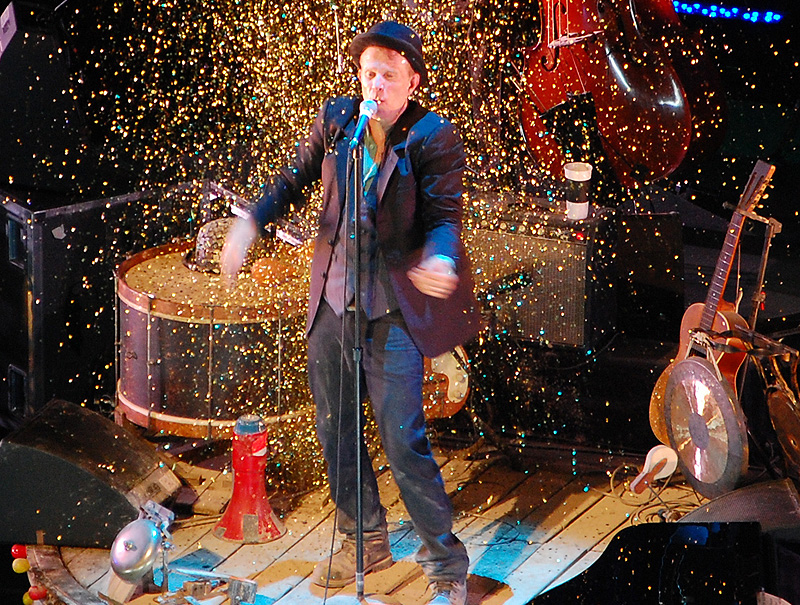
Tom Waits has not made a studio album since 2011. He has been in movies instead. A lot of them. He showed up in the Coen brothers’ The Ballad of Buster Scruggs, Paul Thomas Anderson’s Licorice Pizza, David Lowery’s The Old Man and the Gun. He just filmed Martin McDonagh’s Wild Horse Nine opposite John Malkovich, Sam Rockwell, Steve Buscemi, and Parker Posey – a period Cold War film set in the 1970s and on Easter Island. The trailer has just dropped. McDonagh, who previously cast Waits in Seven Psychopaths, described Waits on screen as “iconic and mesmerizing.”
None of this is a surprise if you have been paying attention. Waits has always belonged to the movies as much as to music. The question is why, and what it says about what he is actually doing as an artist.
The Voice That Films Have Always Wanted
Waits’ voice is a category of its own. It sounds like a man who has been drinking in a bar where the bartender plays old 78s and the neon sign outside flickers. It is weathered in a way that reads as authentic without being explained. That quality is hard to manufacture. Directors have understood for a long time that putting Waits in a frame gives you texture for free.
He has been working with Jim Jarmusch since the 1980s – Down by Law (1986), Mystery Train (1989), Coffee and Cigarettes (2003). The relationship with McDonagh is newer but follows the same logic. Both directors make films where mood and specificity of character are more important than plot efficiency. Waits is useful to both of them for the same reason: he makes scenes feel real through sheer presence. He does not need exposition. He carries his whole biography in his face.
The Music Stopped, But the Persona Grew
It has been 15 years since Bad as Me. That record was a return to form after a string of more challenging theatrical projects – it had “Raised Right Men” and “Back in the Crowd” and felt like a Waits album his older fans could point new ones toward. Then nothing. No album. A few scattered collaborations. A lot of acting.
What is notable is that the absence has not diminished him. If anything, Waits’ reputation has grown stranger and more durable in the silence. His back catalog sells. His influence shows up everywhere from Nick Cave to Angel Olsen to Fiona Apple. Artists who cite him tend to cite not just the music but a way of being in the world – the idea that you can make uncompromising work and still be loved for it eventually.
There is also the matter of his relationship with recorded music specifically. Waits has always been suspicious of the machinery around recording – the business, the promotional cycle, the way albums turn into products. Acting offers something different. You show up, you do the work, you disappear back into the rest of your life. There is no tour to support a film cameo.
What the Cinema Gets That Music Rarely Does
The deepest answer to why Waits keeps appearing in films is probably this: cinema gives him a context where the strangeness is the point. In most pop and rock settings, Waits would be an anomaly – a curiosity from another era, a throwback to be admired from a safe distance. In the hands of directors like McDonagh, Jarmusch, and PTA, he is exactly the right instrument for exactly the right moment.
McDonagh’s films in particular traffic in a very specific kind of menace and dark comedy. They need characters who feel like they arrived from somewhere with a longer history than the film can account for. Waits, playing Malkovich’s brother in Wild Horse Nine, provides that weight without having to do much. The camera does the rest.
Rock and roll – and Waits is very much a rock and roll figure, regardless of the jazz and theatrical overlay – tends not to know what to do with its older artists unless they are legacy acts playing the hits. Cinema has no equivalent problem. A character actor in their 70s is often more valuable than one in their 30s, because the face has accumulated something that reads on screen. Waits at 76 is more interesting to watch than most.
Whether the Music Will Come Back
Waits has not said it will. He has not said it won’t. Interviews are rare and tend to circle around his reluctance to explain himself directly. His wife and longtime collaborator Kathleen Brennan is still around, and the two of them have made every significant piece of work since Swordfishtrombones (1983) together. Whether she has material waiting in a drawer somewhere is anyone’s guess.
What seems clear is that Waits has no intention of making a record because the music industry or his fans want him to. He made that clear when he went silent after Bad as Me without explanation. The next album, if there is one, will exist because it needed to exist, not because a release cycle demanded it.
In the meantime, the films keep arriving. Wild Horse Nine hits theaters November 6. It looks like exactly the kind of movie where Tom Waits, playing a morally ambiguous figure in a decade he understands on a cellular level, will be devastating. That is probably enough.