 Into The Music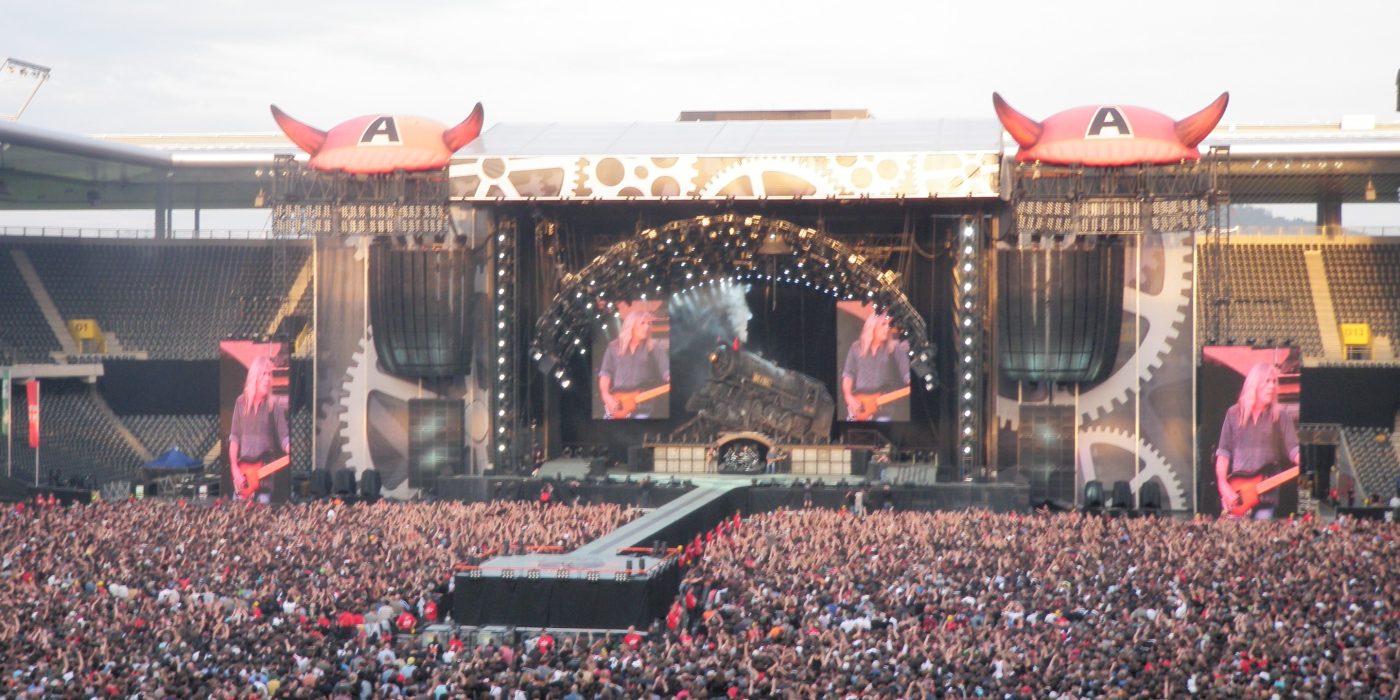
Hard rock and heavy metal share a boundary that’s always been porous, and the distinction matters less to most listeners than it does to the critics and historians who try to maintain it. What they share is the primacy of the guitar, the preference for volume, and the structural centrality of the riff. A riff in this tradition is not an ornament; it’s the load-bearing wall.
The form came into focus in the late 1960s through Cream, Led Zeppelin, and the early Black Sabbath records, which established the vocabulary that has been used, extended, and argued with ever since. Sabbath is the most foundational: “Iron Man,” “Paranoid,” and the title track of their debut are the source material for decades of genre development, from early metal through doom, stoner rock, and every variety of extreme metal that came later.
AC/DC represents a different lineage within hard rock, one that runs through Chuck Berry and Muddy Waters and Little Richard rather than the more psychedelic and blues-rock influenced path of Zeppelin and Cream. Their music is built on economy, every note earns its place, and the Angus Young guitar tone, that specific combination of amp settings and playing style, is one of the most recognizable sounds in the history of recorded music. You know it in the first half-second.
What hard rock and metal have in common culturally, beyond the sound, is a relationship to the live performance that is different from almost any other genre. The recordings are often secondary to the experience of hearing it at volume in a room with other people. AC/DC touring stadiums in 2026 is a continuation of something that has been true about this music since the first time a Marshall stack was turned up past the point of comfort.


okay so I came to hard rock backwards , I got obsessed with Chinese rock bands like Beyond and Black Panther before I ever really dug into the Western stuff, and reading this just made everything click. The riff IS the thing! That same instinct is all over early Cantonese rock. The genre labels are completely different but the DNA is the same 🎸
The riff-as-architecture argument is interesting but I’d push it further , what made early Zeppelin and Sabbath riffs hit differently wasn’t just composition, it was how the low-end translated onto the recording medium. Page’s use of the Supro amp and close-mic’ing created a fundamental frequency response that most modern hard rock recordings have completely lost chasing the loudness war. If you play ‘When the Levee Breaks’ on a proper hi-fi at reference volume, the physical impact is not comparable to anything being mastered today. The riff is the same notes. The experience is not.
Good piece but I’ll say what I always say , articles about hard rock and riff-based music always manage to cover the Atlantic without once mentioning Fela Kuti, whose guitar players were building riff-forward grooves with just as much muscle and far more rhythmic sophistication in the same era. The boundary between hard rock and the rest of the world’s amplified music in the 70s was not a natural boundary. It was a marketing boundary.
This is what I’ve been saying for years , the riff IS the song in hard rock, everything else is just furniture. People talk about Zeppelin vocals or Sabbath atmosphere but go back and listen to “Whole Lotta Love” or “Iron Man” and tell me it’s not the guitar doing the heavy lifting. Clapton understood this too, even when he moved away from pure rock , the riff gives the listener something to hold onto. Great piece for finally putting words to it.
the riff-as-architecture argument is CORRECT and anyone who disagrees has not listened to the intro of Paranoid at proper volume. that’s not a song opening, that’s a building going up.
I’ll give hard rock its credit for the riff, fine. But let’s not pretend the conversation about what built rock and roll architecture is settled. Hip-hop producers were constructing entire sonic worlds out of two-bar loops years before anyone was writing think pieces about riffs as architecture. DJ Premier alone built more memorable hooks in the 90s than most classic rock bands managed in full careers. Different tools, different tradition, but if we’re talking about repetition as the load-bearing element of a song, that conversation has to be wider than Zeppelin and Sabbath.
Okay this article has me fired up because nobody ever brings up how hard rock crossed into Latin music in ways that are still underappreciated. Mana was doing full stadium hard rock in Spanish in the 90s and they were MASSIVE across Latin America while most of the US rock press wasn’t paying attention. Molotov had this punk-hard rock aggression that was completely their own thing. The riff as architecture is universal, it doesn’t belong to any one language or continent, and I wish these genre histories would start reflecting that.
The riff is the riff but I have to say, the first time I heard Caetano Veloso’s electric phase in the late 60s I understood that the guitar doing something threatening and beautiful at the same time is not a uniquely British invention. Hard rock grabbed it and ran with it, sure, but the riff as a force of nature has roots everywhere. Still a great piece though!
The riff works because it does not ask permission. That is all.