 Into The Music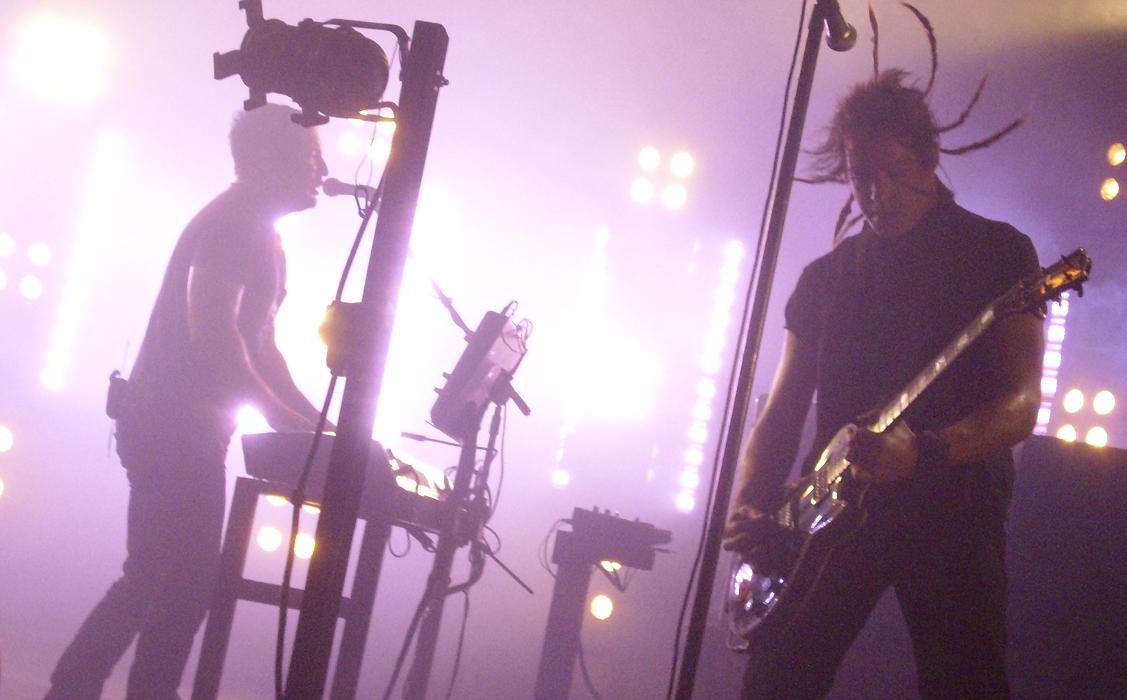
Industrial music has always had a problem with the mainstream, or rather the mainstream has had a problem with industrial music, and for a long time everyone seemed reasonably fine with the arrangement.
The genre was born in the late 1970s as an explicit rejection of the idea that music needed to be pleasant, or coherent, or even technically musical. Throbbing Gristle in the UK and SPK in Australia were making work that was closer to performance art than rock, using tape manipulation, noise, and confrontational imagery to attack the comforts of conventional listening. The name “industrial” came from the label Throbbing Gristle founded: Industrial Records, whose slogan was “Industrial Music for Industrial People.” The irony was intentional and delivered deadpan.
Through the 1980s, the genre splintered. Some of it moved toward the dancefloor, through EBM (electronic body music) acts like Front 242 and Nitzer Ebb, who kept the aggression but added enough rhythm to make the body move. Some of it moved deeper into noise and abstraction, through artists like Einsturzende Neubauten, who famously used power tools and construction debris as instruments. Ministry started in synth-pop and migrated toward something so heavy and mechanized it barely resembled the genre it had grown from.
Nine Inch Nails, beginning in 1989, did something different: they made industrial music that people who did not know what industrial music was could love. “Pretty Hate Machine” and especially “The Downward Spiral” brought the production philosophy of the genre, the layered electronics, the distorted textures, the studied ugliness, to an audience that experienced it as rock and roll, which it was, sort of, in the way that “sort of” can cover enormous distances.
NIN’s commercial success was always controversial in the circles that had claimed the genre before them. Accessibility felt like betrayal to some. But the effect on what was possible in mainstream rock was permanent. After “Broken” and “The Downward Spiral,” a generation of producers and artists understood that abrasion could be a pop tool, not just a fringe provocation.
The Nine Inch Noize collaboration with Boys Noize, which debuted at Coachella this past weekend to what sound like genuine crowd fervor, represents another mutation. This version of the music takes the NIN catalog back toward its electronic architecture and rebuilds it for a club environment. Industrial meeting techno is not a new concept. Nitzer Ebb covered this ground in 1987. But the scale of doing it at Coachella, in the Sahara tent with a theatrical production, positions industrial music as something other than what it has mostly been for the past twenty years: a reference point, a sound that shaped things without fully occupying them.
What Nine Inch Noize’s success, if it becomes a success, would mean is harder to say. Industrial music’s whole posture was built on refusal, on the idea that difficulty was a feature and accessibility was the thing being critiqued. An industrial act that is enormous and beloved is almost a contradiction in terms. Trent Reznor has lived inside that contradiction for three decades and seems to find it generative rather than paralyzing.
The genre that invented machine music at the moment machines were becoming terrifying has now arrived in an era when machines are everywhere and the terror is ambient rather than acute. Industrial music as a critique of industrial society might be the most timely it has ever been. The timing is almost too good, which is, given the genre’s history, exactly the kind of thing it would never allow itself to enjoy.