 Into The Music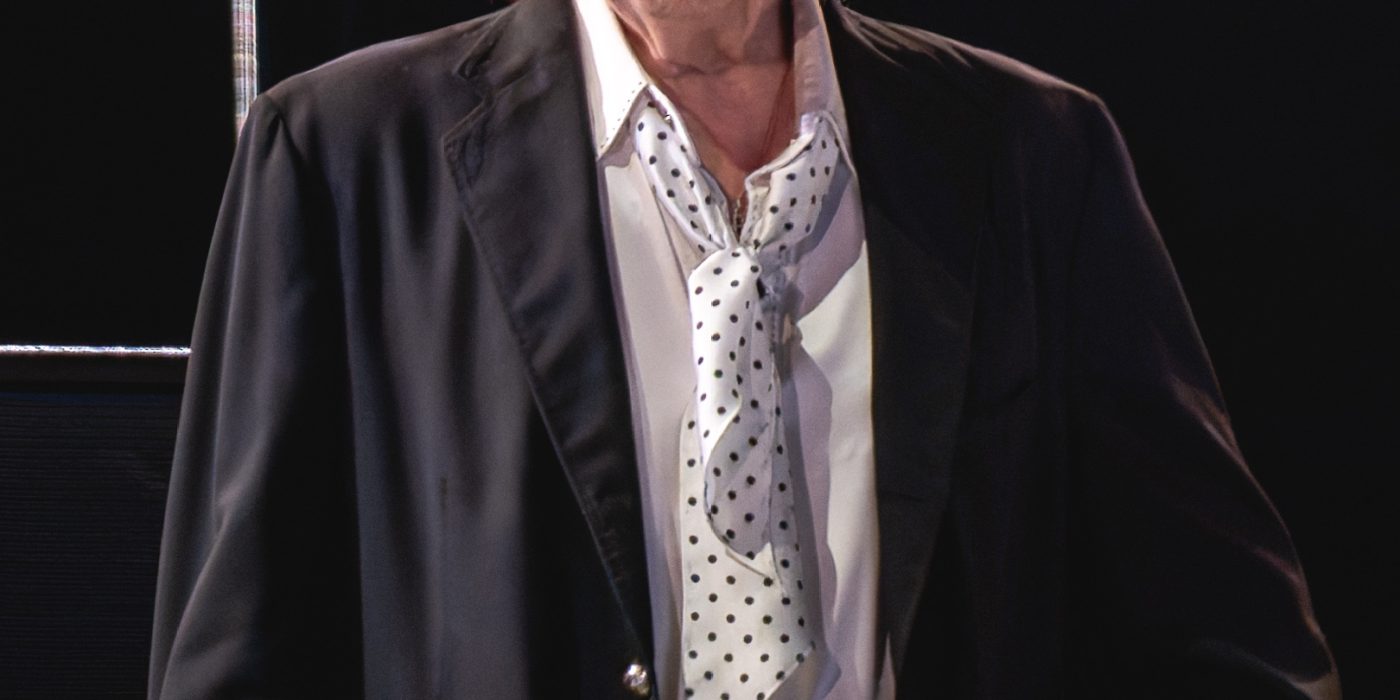
Bob Dylan opened the 2026 leg of his Rough and Rowdy Ways tour on Saturday night in Omaha, Nebraska, and promptly reminded everyone that “predictable” is not a category he operates in.
The show at the Orpheum Theater introduced several significant changes. Dylan scrapped his grand piano in favor of a small keyboard placed in the center of the stage, had guitarists Bob Britt and Doug Lancio play acoustic instead of electric, and reduced the number of Rough and Rowdy Ways songs in the set from nine to six. An electric guitar sat on his amp all night and he never touched it.
The setlist contained multiple surprises, starting early: after the standard opener “I Will Be Your Baby Tonight,” Dylan pulled out “The Man in the Long Black Coat” from 1989's Oh Mercy – his first performance of that song since 2013. “Don't Think Twice, It's All Right” appeared, as did Bo Diddley's “I Can Tell,” which had previously been limited to his Outlaw Festival appearances.
The biggest moment came near the end of the evening. Dylan played Eddie Cochran's 1958 rockabilly track “Nervous Breakdown” – a song he had never performed live in his entire career until Saturday night. Phones were banned at the venue so no video emerged, but fans captured audio recordings.
The Omaha show was not without difficulties. Reports from concertgoers describe issues with microphone placement – Dylan apparently moved it around the stage throughout the night, each time it landed with a loud boom – and the sound quality on recordings reflects some of those struggles. But by multiple accounts, when he was comfortable at the microphone, his voice came through well.
Dylan's last American shows were part of the Outlaw Festival tour in September 2025, which were famously strange even by his standards: he wore a hoodie pulled tight over his face and positioned a music stand and lights near his piano that made it nearly impossible for audiences to see him. The hood-wearing strategy seemed to be a response to phone filming at large outdoor venues – the theater circuit, where phones are pouched at the door, apparently doesn't require that approach. In Omaha, fans had a clear view.
The Rough and Rowdy Ways tour continues through the spring. Dylan's restlessness with his own setlists and arrangements has been one of the more interesting ongoing stories in live music for the past several years – this tour has already seen him restructure the same songs multiple times, try different instrumentation, and occasionally pull out material that hasn't been played in a decade or more. The first night of the 2026 leg suggests that tendency is not going anywhere.
What I always find myself tracking with Dylan live is how he redistributes the pulse when he strips things down acoustically, where the band used to hold the tempo, now it falls entirely on him, and you can hear how he pushes and pulls against the beat in ways that a tighter rhythm section would never allow. The Cochran cover is an interesting choice too, rockabilly has this very specific snare placement that Dylan almost certainly bends into something else entirely.
TJ, I hear you on the pulse redistribution, but I want to ask about something different , when Dylan strips down acoustically, whose tradition is he actually working in? Because Eddie Cochran is not folk, Eddie Cochran is rockabilly, which is as much a product of the Texas-Mexico border as it is anything else. That twang and syncopation has East LA fingerprints all over it even if that history doesn’t always get acknowledged. When Dylan plays that material acoustic in Omaha he’s pulling on a thread that runs way further south and west than most of the Dylan commentary bothers to trace.
Carlos raises the right question. The Eddie Cochran lineage matters here because Cochran sits at a very specific intersection , he was rockabilly but also presaged the garage sensibility, and Dylan has always been more interested in folk’s cousin genres than pure folk itself. But the tradition Dylan is working in acoustically is actually closer to the country blues line that runs through Robert Johnson and Woody Guthrie , the single voice as moral witness, unaccompanied or nearly so, accountable to nothing but the truth of the lyric. Cochran fits that frame as a kind of sideways entry point, which is very Dylan.
There’s something that moves me about Dylan opening in Omaha, not New York, not LA, not somewhere that would announce itself, just Omaha, Nebraska, with an Eddie Cochran cover and whatever truth he decided was right for that night. I grew up between Israeli folk music and American rock, and that tension between rootedness and restlessness was always where the best stuff lived. Dylan at 84 still refusing to telegraph what he’ll do next feels like an act of defiance that’s also an act of generosity. He’s saying: I’m still here, and I’m still looking for it. That matters.
Dylan opening in Omaha is more interesting than opening anywhere else would have been. The geography is the statement.
What draws me to this is the word ‘predictable’ , that Dylan refuses to be it. In the qawwali tradition, we speak of hal, the spiritual state that descends on a singer mid-performance and transforms what was planned into something else entirely. The great ustad Nusrat Fateh Ali Khan would sometimes hold a note until the audience felt the room shift. I think Dylan, for all his American roots, is operating in a similar territory , the performance is not a delivery of what you paid to hear, it is a searching. Stripping down acoustically in Omaha and opening with Eddie Cochran is not a nostalgic gesture. It is an act of spiritual stubbornness. He is still searching, which at his age is the most moving thing I can imagine.
I have absolutely zero business being this excited about a Bob Dylan tour when my formative years were spent moshing to Less Than Jake, but here we are!! An Eddie Cochran cover as the opener is genuinely unhinged in the best way. My entire Dylan knowledge comes from a road trip where my dad refused to change the CD, so I’m basically learning about this guy in real time while everyone else in the comments sounds like they have a PhD. Love it. Will never admit this to my ska friends.
There is something about an artist refusing to be predictable that cuts right to the core of what it means to perform with honesty. In flamenco we call it duende , that moment when the performer stops performing and starts bleeding. Dylan choosing an Eddie Cochran cover to open a 2026 tour feels like exactly that kind of gesture. He doesn’t owe us familiarity. He never did.
I cried reading this, I’m not even ashamed. There’s something about Dylan still going out there and doing the unexpected thing , stripping it down, covering Cochran , that feels like proof that music can stay alive in a person for an entire lifetime. I’ve been listening to “Murder Most Foul” on repeat lately and the acoustic overhaul makes complete sense if you’ve been sitting with that record. He’s not trying to win anyone back. He’s just following something.
Mia, I understand the feeling, but I’d gently push back on the ‘proof of life’ reading , I’ve seen Dylan live four times across three decades, and the strip-it-down acoustic move is one he cycles back to deliberately, almost strategically. It’s not always vulnerability, sometimes it’s control. The most interesting version I saw was Vienna in 2019, where he played an entire hour with almost no eye contact and complete harmonic authority. It wasn’t emotional. It was precise. Which is its own kind of statement.
What I keep thinking about is Eddie Cochran specifically as the choice , not Woody Guthrie, not Hank Williams, but Cochran, who represents a very particular American vernacular energy, raw and physical and a little dangerous. In highlife, the great bandleaders like E.T. Mensah and Ebo Taylor had a similar instinct: reach sideways into something adjacent and unexpected, not backward into your own canon. Dylan covering Cochran isn’t nostalgia. It’s a statement about where the pulse of American music actually lives, underneath all the mythology that’s been built on top of it.