 Into The Music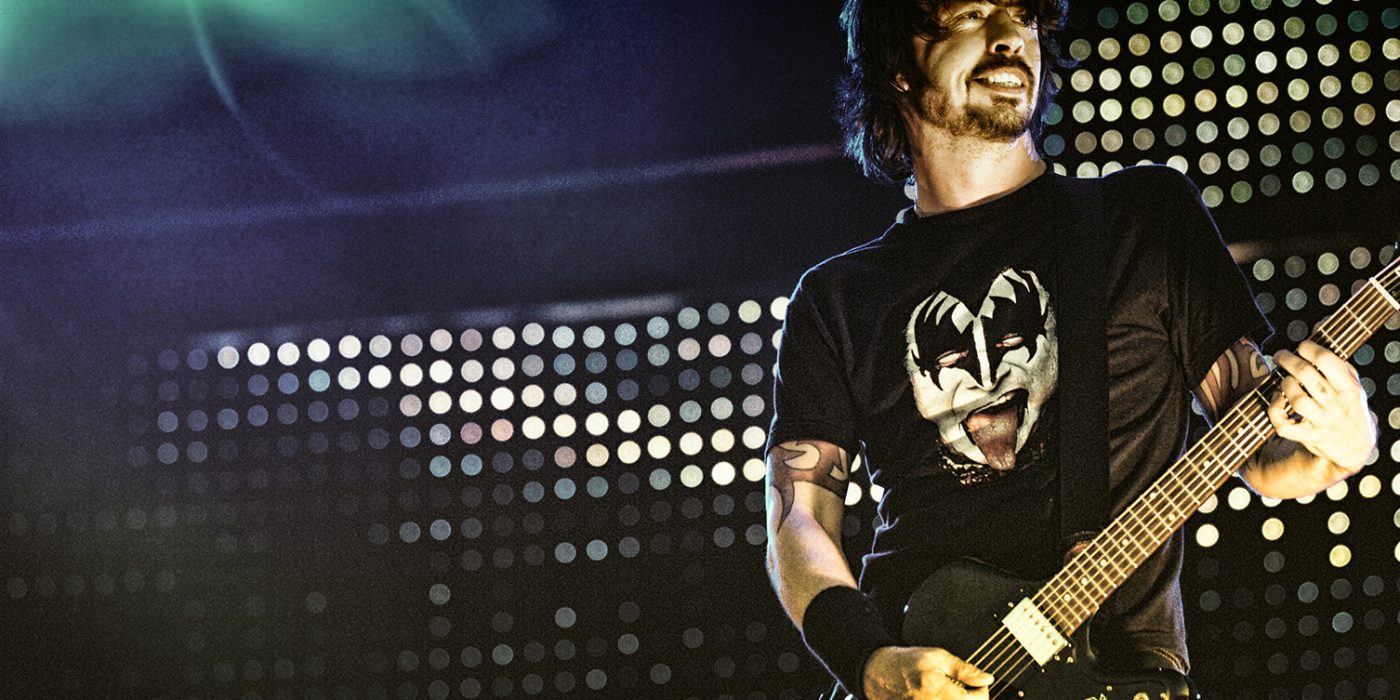
Dave Grohl has been through a lot in the last four years. Taylor Hawkins died onstage in Bogota in March 2022. His mother followed four months later. Then in 2024, he publicly announced he had fathered a child outside his marriage. And through all of it – through the loss, the grief, the public unraveling – he kept working. Kept touring. Kept going.
In a new interview with The Guardian, Grohl finally talks about what it actually cost him to operate that way. The headline number is almost absurd: therapy six days a week for 70 weeks, totaling more than 430 sessions. That is not a man casually exploring his feelings. That is a man trying to excavate himself from underneath decades of armor.
The armor has always been the work. Grohl has talked about this pattern before – the way writing songs, performing, staying busy served as emotional processing. But he admits now that it only went so far. “From the loss of Kurt to the loss of Taylor, I was afraid to sit and actually let those things into my heart,” he told The Guardian. That is a striking thing to say, coming from someone whose public persona is relentless optimism and kinetic energy. The guy who crowd-surfed in a throne. The guy who performs with a broken leg. The guy who turns every moment into joy. What was he not letting himself feel?
The infidelity revelation changed that calculus. Grohl says that after releasing his Instagram statement – spare, dignified, offering nothing beyond the bare minimum – he had to “turn everything off, one of those things being my concern for what other people think.” That sounds like a relief as much as a reckoning. The relentless audience-facing version of Dave Grohl – the guy who is perpetually grateful, perpetually game – had to go quiet for a while.
What comes through in the interview is not exactly closure. He still will not talk about the Josh Freese situation, the drummer who played a single tour with the Foo Fighters and was let go without explanation. Bassist Nate Mendel said only that “this is what is best for us.” Grohl did not address it at all. Some things are still sealed off.
But the Taylor Hawkins story he tells is genuinely affecting. He fell asleep on a couch, woke up to a dream where Hawkins was sitting next to him, tan and happy, and when Grohl said “we miss you so much,” Hawkins smiled. Grohl asked where he was. Hawkins said “Dude -” and then Grohl woke up. “Fuck, I almost had it,” he says. It is hard to read that and not feel something.
The Foo Fighters still exist. They are still making music. And Grohl sounds, for the first time in a long time, like someone who has started to locate the difference between processing pain through art and actually processing pain. That is not a small distinction. For a lot of musicians who have built their whole identity on forward motion and output, it can take a decade – or more – to learn it.
430 sessions is a long time in a room with yourself. Something apparently shifted.

430 sessions. I keep coming back to that number. Losing someone you made music with is its own category of grief, it lives in the body differently than other losses. I wrote for almost a year after losing a bandmate and it still wasn’t enough to get to the bottom of it. Whatever he found in those sessions, I’m glad he kept going back.
ok I only recently got into Foo Fighters properly (I know, I know) but this headline completely stopped me. 430 sessions is SO much. Like I knew Dave Grohl had been through a lot with Taylor Hawkins passing but reading about all of it together is a lot to take in. genuinely respect that he’s talking about this openly.
There is a long tradition across many cultures of artists carrying grief publicly, the griot who mourns a king, the praise singer who holds communal memory. What strikes me about Grohl’s story is how thoroughly modern it is in its honesty: the number (430!), the clinical frame of therapy, and yet underneath it all the same ancient wound of losing someone whose voice was woven into your own. The fact that this is being written about so openly in a rock context feels meaningful. That conversation has not always been welcome there.
Chioma, the griot comparison is the right lens here. What interests me from an industrial music standpoint is how grief tends to strip away ornamentation , both in therapy and in sound. Einstürzende Neubauten built an entire aesthetic around that kind of raw structural collapse. 430 sessions is its own kind of deconstruction: tearing down the architecture of the self piece by piece to find out what load-bearing walls remain. Grohl’s output since Taylor Hawkins died has that same quality , less decoration, more weight.
You know, this piece hit me somewhere deep. I saw Dave Grohl perform with Nirvana exactly once , it was 1991, a small club, we almost didn’t even go because my friend had a cold , and there was a wildness in him even then, this physical joy, like he was playing for his life. Losing Taylor Hawkins and then his mother in the same year, I can’t imagine. I lost my husband in 2019 and I’ll tell you, 430 sessions doesn’t sound excessive to me. It sounds like someone doing the work. The bravest thing is to keep showing up. Dave Grohl keeps showing up and that means something.
430 sessions!!! That number is staggering but also kind of beautiful? Like the discipline of that, showing up for yourself again and again the way you’d show up to rehearsal. Dave Grohl has always given everything he has to music and it sounds like he brought that same energy to healing. So much respect for him being open about this 🙌
Jasmine YES, the discipline comparison really hits. In salsa you have this saying that the musician who shows up every day to practice even when they feel nothing is the one who plays the best when everything is on the line. 430 sessions is that same energy. He wasn’t waiting to feel ready, he just kept showing up.
Ray’s salsa analogy is interesting to me because it maps onto what the data actually shows about creative consistency. Artists who maintain a regular output cadence , even through personal turmoil , tend to have significantly longer catalog shelf lives on streaming platforms. Grohl’s Foo Fighters catalog has stayed remarkably stable on Spotify even through the post-Hawkins period, which suggests the audience stuck with him. The 430 sessions thing is a striking number, and what I keep wondering is whether it correlates to a specific shift in his output going forward. We’ll be able to see it in the numbers.
Grief doesn’t care who you are. 430 sessions is just the work.
Man, losing your bandmate AND your mother in the same year? That’s a weight no groove can carry alone. James Brown used to say the one is everything, the downbeat holds you when nothing else will. I hope Dave found his one again. The world needs him making music.
Four hundred and thirty sessions and yet you still invoke James Brown. Grief is not a groove, mon ami.
As a music teacher I find myself thinking about this from a pedagogical angle , because 430 sessions of therapy is, at its core, the same principle I try to teach my students: you show up, you do the work, and you trust that the accumulation matters even when a single session feels useless. Music literacy works exactly like that. The student who comes in twice a week for three years and feels like they’re barely progressing is building something they can’t see yet. Grohl clearly understands disciplined repetition. It’s how he became the drummer he was, and apparently it’s also how he healed. That’s a lesson worth passing on.
Losing someone while you are still onstage , Taylor Hawkins going that way , that kind of wound does not close. In flamenco, duende is the force that comes through suffering, the thing that makes a performance true rather than just technically correct. Grohl doing 430 sessions is looking for duende the long way, the only honest way. You don’t perform your way out of that grief. You sit in it until it becomes something you can carry. I hope he found some peace. The music he makes next will tell the truth of it.