 Into The Music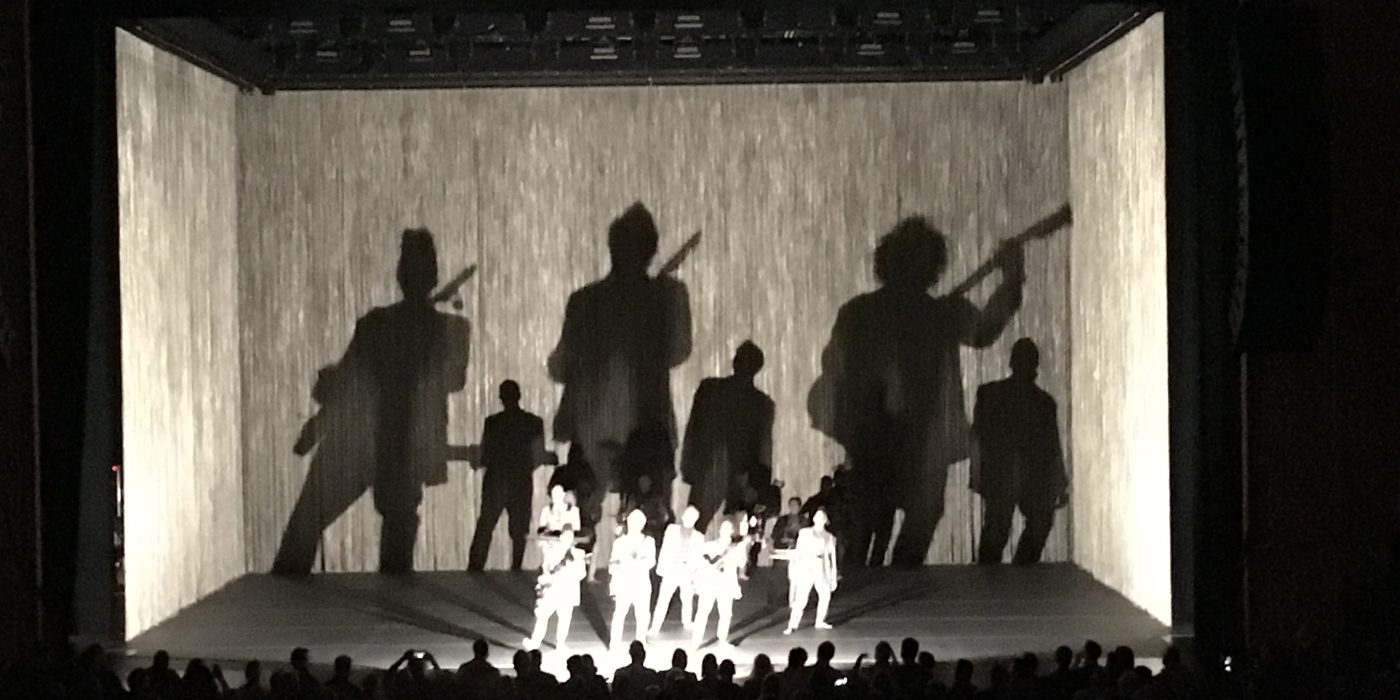
David Byrne performed “When We Are Singing” on The Late Show with Stephen Colbert Monday night, bringing his full theatrical ensemble to late-night television and using the moment to explain something that has been drawing attention on his current tour: the decision to weave ICE footage into a live performance of “Life During Wartime.”
The performance was quintessential Byrne. Blue-clad dancers, full choreography, Byrne himself circling the stage with the unselfconscious energy of someone who stopped worrying about looking cool several decades ago. “When We Are Singing” comes from Who Is the Sky?, his 2025 album, and it translates well to the late-night format. It is a song built for shared spaces.
But the more revealing part of the appearance was what Byrne told Colbert about “Life During Wartime.” On tour, Byrne has been licensing actual ICE footage and projecting it at the close of the song. Not for the whole song, he was careful to note. Just the final moments. “If we showed it for the whole song it would be kind of sad and depressing,” he said. “But we show it at the very end.”
It is a pointed choice. “Life During Wartime” was written in 1979, during what Talking Heads described as a fictional wartime scenario. The song’s paranoid urgency, the refusal to stop moving, the sense that normalcy has been suspended indefinitely. Byrne is clearly aware of how those themes land right now. He said the song “feels different” in the current context.
There is something interesting about an artist of Byrne’s age and reputation making this call. He is not a newcomer trying to signal political awareness. He is someone who has been careful over the years not to make his concerts feel like lectures. The footage at the end of a song is a deliberate piece of staging, not a rant. It asks the audience to sit with something uncomfortable without telling them what to think about it.
Byrne also talked with Colbert about why he keeps reinventing his live shows. The previous tour was grey. This one is colorful. He talked about collaboration, about wanting to keep the audience genuinely surprised. It was a good conversation, the kind that late-night rarely makes room for.
The current tour mixes material from Who Is the Sky? with Talking Heads songs, including “Psycho Killer.” For audiences who come expecting the nostalgia tour, they will get something more complicated. That is, in most ways, exactly the point.
David Byrne has always been the kind of artist who treats the stage as more than a stage , there’s a whole lineage of that in rock, going back to the political folk scene, but Byrne does something different than Guthrie’s guitar sticker. He implicates the audience in the discomfort. Using actual ICE footage in a live performance context is confrontational in a way that a protest song on a record simply isn’t. You can’t just listen to it while you’re driving. That matters. I saw him do something similar years ago , the physical staging alone made the hairs on your arm stand up before a word was sung.
What Byrne is doing with the ICE footage connects to a long tradition of artists embedding documentary witness into performance , Fela Kuti did something structurally similar when he turned his concerts into hours-long indictments of the Nigerian state, using the communal experience of the music to make political reality impossible to look away from. The difference is that Fela risked everything. Byrne is doing this from a position of considerable safety, which I don’t say to diminish the gesture, but it does change the stakes of the storytelling. Still, in a late-night television context, where the entire apparatus is designed to smooth things over, bringing that footage in is a real rupture.