 Into The Music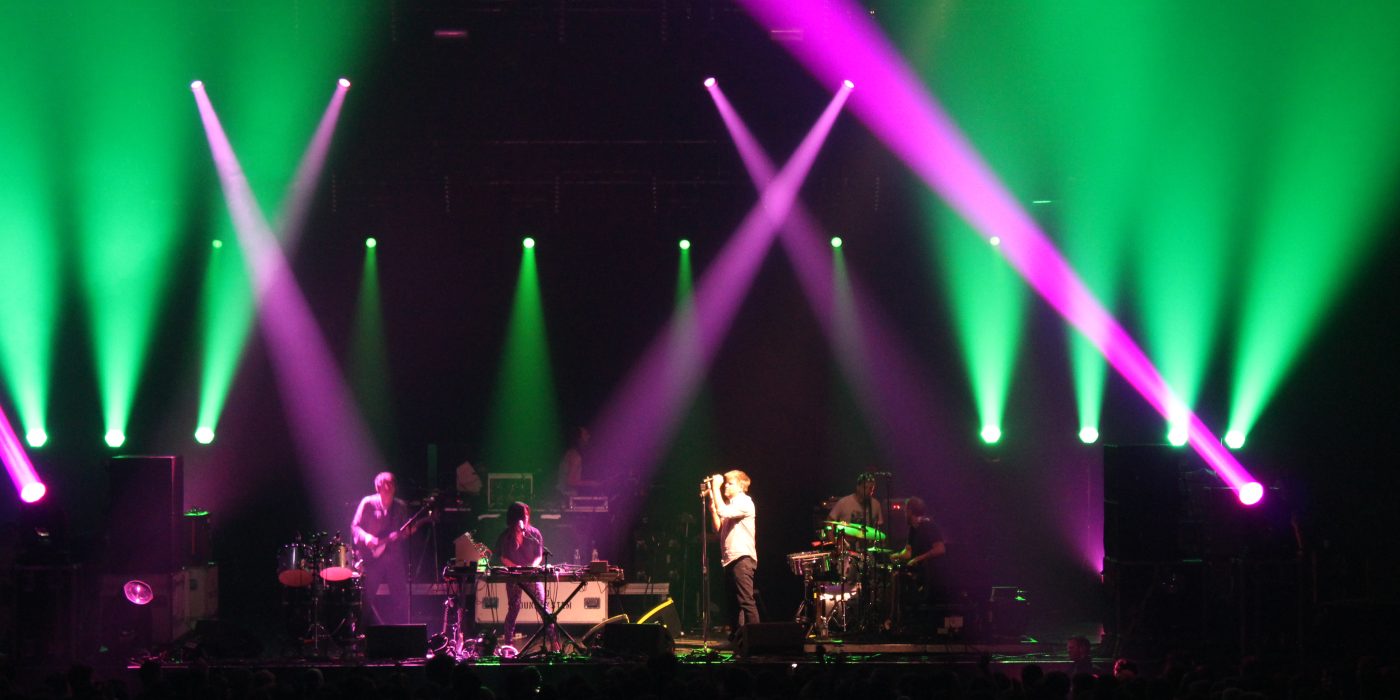
There is a moment in a certain kind of song where the guitar riff stops being about tension and starts being about release, and the beat underneath it becomes the only thing that matters. That moment is where indie dance lives. It is not a genre in the sense that death metal or bluegrass is a genre. It is more like a temperature. A set of priorities. Guitar bands who figured out that rhythm was not the enemy of feeling, that you could have a song built to make people move and still have it mean something.
The lineage usually gets traced back to the post-punk dance experiments of the early 1980s: A Certain Ratio, Gang of Four, early New Order. The argument is that those bands were the first to take punk’s stripped-down energy and consciously cross it with the groove-oriented priorities of funk and disco. They were doing it partly out of principle, the Manchester scene had a particular relationship with Black American music that was more than borrowing, and partly because rhythm sections tend to find grooves on their own once the guitarist stops trying to dominate everything.
The term “indie dance” as a commercially useful descriptor mostly arrived with the mid-2000s wave: Franz Ferdinand, LCD Soundsystem, Hot Chip, The Rapture, Holy Ghost!. These were bands who had clearly internalized the New Order lesson, that four-on-the-floor and a guitar are not incompatible, and who had also absorbed the production aesthetics of house and techno without becoming either. They made records that worked at volume in a room full of people and also worked on headphones walking home afterward. That dual utility is harder than it sounds.
LCD Soundsystem is the obvious peak. James Murphy’s project operated in indie dance territory with a self-awareness that sometimes tipped into self-parody but mostly just tipped into greatness. “Losing My Edge,” “All My Friends,” “Dance Yrself Clean” are songs that understand exactly what they are doing and do it anyway, which is a different and more interesting thing than songs that accidentally stumble into being good. Murphy knew the history he was working inside and chose to be explicit about it. The result is music that feels simultaneously like commentary and like the thing it is commenting on.
The current moment for indie dance is less centralized than it was in 2005, which is probably a sign of health. There is no single scene, no obvious geographic center, no one label hoovering up all the relevant acts. Instead there are pockets: the London club-adjacent guitar bands processing Talking Heads and ESG, the bedroom producers who came up on Mac DeMarco and ended up making something far more physical, the American indie acts who discovered that a four-to-the-floor kick drum does not actually compromise their artistic credibility.
Bloc Party, perhaps counterintuitively, have always been indie dance even when they were being described as post-punk revivalists. The rhythm section of Gordon Moakes and Matt Tong on Silent Alarm was doing something closer to dance music than to Wire. The songs were urgent in a particular way that had more to do with tempo and groove than with noise. Their new material with Trevor Horn, from what the BBC 6 Music Festival preview suggests, leans harder into that identity than anything they have done before.
The other thing worth saying about indie dance as a genre category is that it has consistently been better at integrating its influences than most. The cross-pollination between guitar band culture and club culture that indie dance represents is not always comfortable, but it has produced some of the most genuinely exciting music of the past forty years. That it does not have a cleaner narrative or a more definitive canon is not a failure. It is a feature. The genre that refuses to fully cohere is often the one still doing interesting things, because it has not yet been fully described, and anything that has not been fully described still has room to become something new.
Interesting piece but I keep getting stuck on the production question , what’s actually making that moment when the guitar ‘starts being about release’ happen sonically? Is it the compression on the rhythm guitars, a specific reverb tail that opens up? Because New Order were using a Simmons drum machine and that specific attack profile is a huge part of why the beat feels like it lifts. I’d love to know what the modern indie dance acts are running through for that same effect.