 Into The Music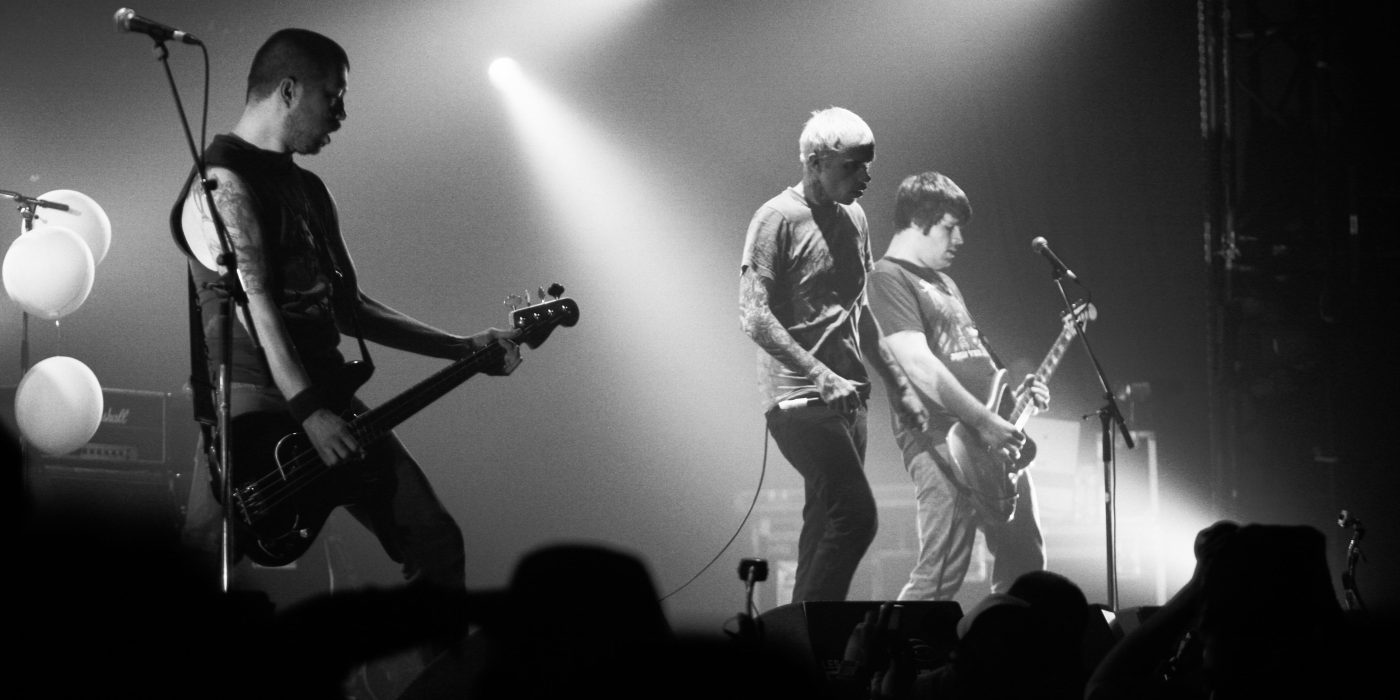
Post-hardcore emerged from the mid-1980s as the hardcore punk scene started fracturing into artists who wanted to keep the intensity but expand the vocabulary. The Minutemen were doing it before the term existed, combining punk energy with jazz structure and political directness. Husker Du’s Zen Arcade in 1984 was a double album that did things hardcore wasn’t supposed to do.
By the late 1980s and into the 1990s, a group of bands were making music that retained the abrasiveness of hardcore but pushed into more complex song structures, more varied dynamics, and more emotionally wide-ranging lyrical territory. Fugazi is the canonical example, not because they were the first but because they were the clearest articulation of what the genre could be at its best: politically serious, sonically adventurous, fiercely independent, and built for live performance in a way that made their records feel like documents rather than products.
Converge has been one of the defining post-hardcore acts for over 30 years. Their 2001 album Jane Doe is one of the most intense and accomplished records in the genre’s history, a sustained expression of emotional and sonic extremity that doesn’t let up for 46 minutes. The fact that they’re still releasing music with this much forward momentum in 2026 is, by itself, a remarkable statement about what a band can sustain.
The genre has fractured and recombined many times since the 1990s. Screamo, math rock, noise rock, and metalcore have all drawn from post-hardcore and fed back into it. The common thread is the refusal of comfort: music that wants to locate the places where form breaks down and feeling has to do the work instead. That’s what Converge has always been doing, and what the best post-hardcore still does.
What the article nails about post-hardcore is that fracturing wasn’t a failure , it was the point. The Minutemen understood something that a lot of their contemporaries didn’t: intensity is a tool, not a destination. You can push just as hard harmonically or rhythmically as you can with volume. As someone who spends a lot of time thinking about how production shapes meaning, I find post-hardcore interesting precisely because the intensity stays but the container keeps changing. That restlessness is actually more true to the original hardcore spirit than strict adherence to the form would have been.
I’d push back slightly , saying fracturing was “the point” retrofits a kind of intentionality onto what was also just musicians being restless and broke and figuring it out in real time. The Minutemen weren’t following a theory; they were following their ears. Which is actually a more generous reading of the whole thing than “they meant to do it.” But yeah, post-hardcore being legit is not a debate I’ll have in 2026. We won that argument in 1994.
Ha, I love Dana’s point here! I came to post-hardcore late and from a very different direction , polka, of all things, which is also full of musicians who were just making it up as they went and calling it a tradition later. The retroactive intentionality thing is everywhere in music history. Every scene sounds more coherent in the retrospective than it ever did in the room.
The article’s point about intensity without genre rigidity is actually what created the conditions for a lot of music people don’t associate with post-hardcore at all. Taylor’s ‘All Too Well (10 Minute Version)’ has more structural DNA from confessional post-hardcore , the long build, the refusal to resolve neatly, the emotional overstay , than from any pop tradition. I know that sounds like a stretch but the songwriting ambition of that era didn’t come from nowhere. Folk and rock were absorbing exactly the permission that post-hardcore gave artists to take up space and not apologize for the length of a feeling.
I got into this whole world through ska-punk which is maybe the silliest on-ramp imaginable but it eventually landed me at Fugazi and Jawbreaker and I have absolutely no regrets. My taste was chaotic but it got me somewhere real eventually 😂 The article’s point about intensity vs. expansion is so good , post-hardcore just kept asking “why not both” until someone had to listen.
The Minutemen are mentioned and then the article moves on. This is a mistake.
The fracturing the article describes reminds me of what happens in oral poetic traditions , the moment a form becomes too defined, it splinters, and the splinters carry more life than the original vessel. Post-hardcore refusing to stay in its lane is not incoherence; it is the natural behaviour of any artistic form that takes intensity seriously. Intensity cannot be contained. The Minutemen, Fugazi, later Refused , what connects them is not sound but a refusal of false resolution, which is, if you think about it, also what drives the best of the Arabic qasida tradition.
Post-hardcore and flamenco have never been mentioned in the same breath and yet reading this I kept thinking: yes. The duende. The thing Lorca wrote about , that dark sound that arrives when technique stops being enough and something rawer takes over. The Minutemen had it. Fugazi had it. It’s not a genre thing, it’s a moment-of-truth thing, and when it happens you cannot mistake it for anything else.
Luz, duende and post-hardcore , okay, this is the comparison I didn’t know I needed. And it makes me think of Cuff the Duke out of Oshawa, who were doing this thing around 2004 where the intensity had that same quality of arriving from somewhere deeper than the song itself. Or Shotgun Jimmie from New Brunswick, who could strip the genre down to its bones and still leave you wrecked. The emotional logic you’re describing , that dark sound that arrives unbidden , that’s what the best Can-con post-hardcore was reaching for too, even if nobody ever wrote about it in those terms.
The fracturing described here is a pattern I recognize from the study of oral literary traditions , when a form becomes too codified, the most vital artists don’t argue with it, they simply start doing something else. What’s notable about post-hardcore is that the fracture produced so many genuinely distinct lineages simultaneously: the spoken word experiments, the jazz inflections, the melodic openings. It’s generative chaos, which is different from mere disorder. The Minutemen alone could sustain a semester’s worth of discussion on this.
The article correctly identifies the structural restlessness of post-hardcore but doesn’t quite reach the deeper question: what happens when the refusal of genre constraints itself becomes a constraint? In Krautrock, Can solved this through repetition , not rigid repetition but evolving repetition, the motorik beat as a frame that could hold anything inside it. The most interesting post-hardcore bands found something similar. The ones who just rejected structure without replacing it with anything collapsed. Structure is not the enemy. Dead structure is.