 Into The Music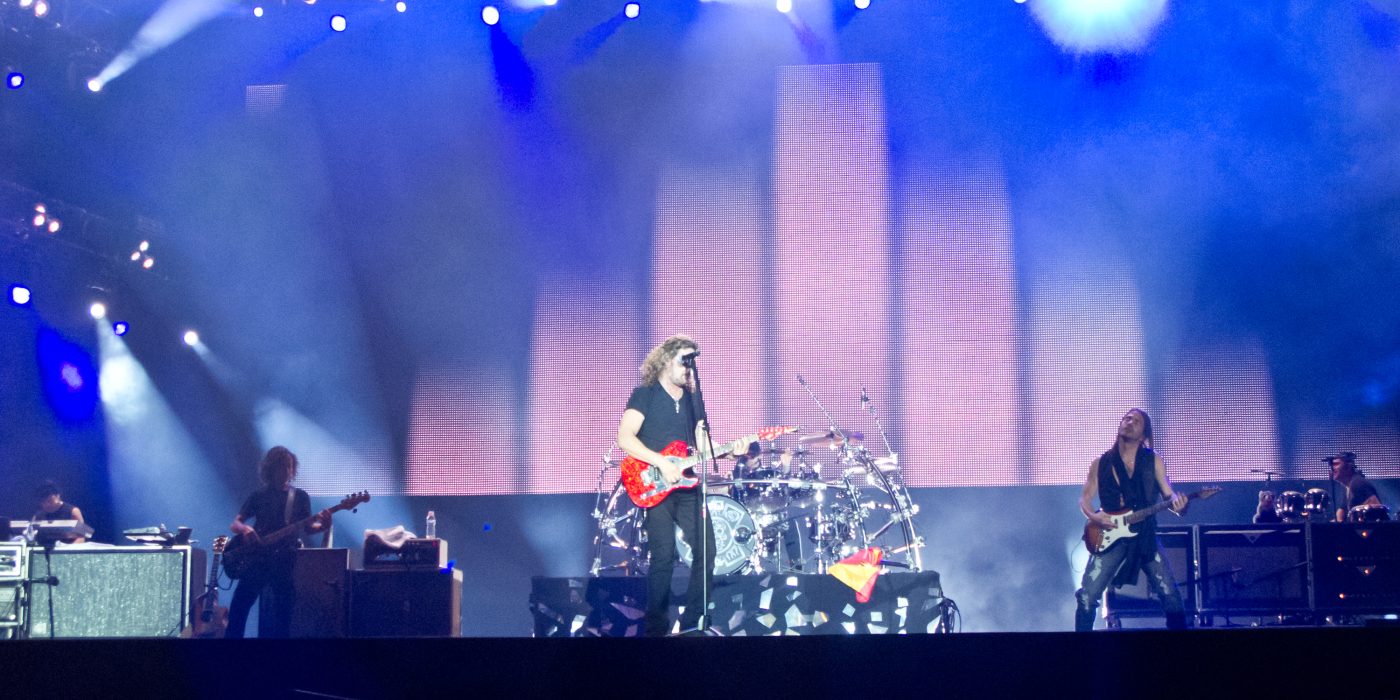
Maná just played Miami on their Vivir Sin Aire tour, and the crowd was enormous. This is not news in the sense that anything unexpected occurred. Maná filling arenas is as close to a constant in Latin music as anything gets. But it is a useful reminder that rock en Español is not an artifact or a footnote. It is a living genre with a global audience that has never actually stopped growing.
Rock en Español emerged as a distinct and self-conscious movement in the 1980s, built on the collision of British and American rock with Latin American youth culture that was navigating political upheaval, urbanization, and the question of what it meant to be modern and Latin at the same time. The early scene was centered in Mexico City and Buenos Aires, and the bands that defined it, Soda Stereo, Los Fabulosos Cadillacs, Caifanes, Maná, were not making a translation of something that existed in English. They were making something genuinely their own.
Soda Stereo’s Gustavo Cerati in particular deserves more attention outside Latin America than he typically receives. His approach to melody, arrangement, and texture was sophisticated in ways that put him alongside the best British post-punk songwriters of his generation. His death in 2014 was a genuine loss for anyone who cares about pop music, not just for fans of Spanish-language rock.
The 1990s brought the genre its commercial peak in the United States. MTV Latino, the Latin Grammy, and crossover mainstream exposure meant that bands like Maná, Jaguares, and Molotov were reaching audiences who had never previously encountered music in Spanish. The genre was pluralistic from the start: Los Fabulosos Cadillacs incorporated ska, cumbia, and funk. Café Tacvba absorbed electronic music and folk. The range was broader than the single label suggested.
What the genre looks like in 2026 is harder to summarize. It does not have a single center anymore. Mexico City still produces important rock music. Buenos Aires remains one of the most vibrant scenes in the hemisphere. But Colombian, Chilean, and Peruvian artists are also contributing in ways that were less visible twenty years ago. The internet has made the geography less meaningful than it used to be.
There is also a generational conversation happening about what the term means now. Younger artists who grew up with rock en Español are producing music that incorporates reggaeton, trap, ambient, and experimental production alongside guitar-driven sounds. The genre’s defining feature was never the guitars. It was the insistence on doing something in Spanish that did not need to translate or defer to an English-language original.
That insistence is still there. And it still matters. When Maná fills an arena in Miami in 2026, the crowd is not there for nostalgia. They are there because the songs hold up and the tradition they represent never stopped being relevant. Rock en Español was never a moment. It was a movement that earned its permanence.
The framing of ‘permission’ is the tell. No genre that required permission ever mattered long-term.
What interests me about Maná filling arenas in Miami is how that space itself becomes a site of cultural assertion , the audience isn’t just listening, they’re occupying geography. Laurie Anderson talked about performance as a way of making a claim on space. Rock en Español has been doing exactly that for decades, with or without a feature in the right publications.
okay I know NOTHING about Rock en Español academically but I grew up going to quinceañeras where Maná was playing and now reading this I realize I’ve been a fan my whole life without ever calling it that??? Like the music was just THERE, it was just what adults played at parties. The idea that it “never needed permission” hits different when you realize it was never asking for it in the first place , it was just living its life.